Sport on Earth › Games › Gym Class Games › British Bulldog
Gym Class Games · Tag & chase games
British Bulldog
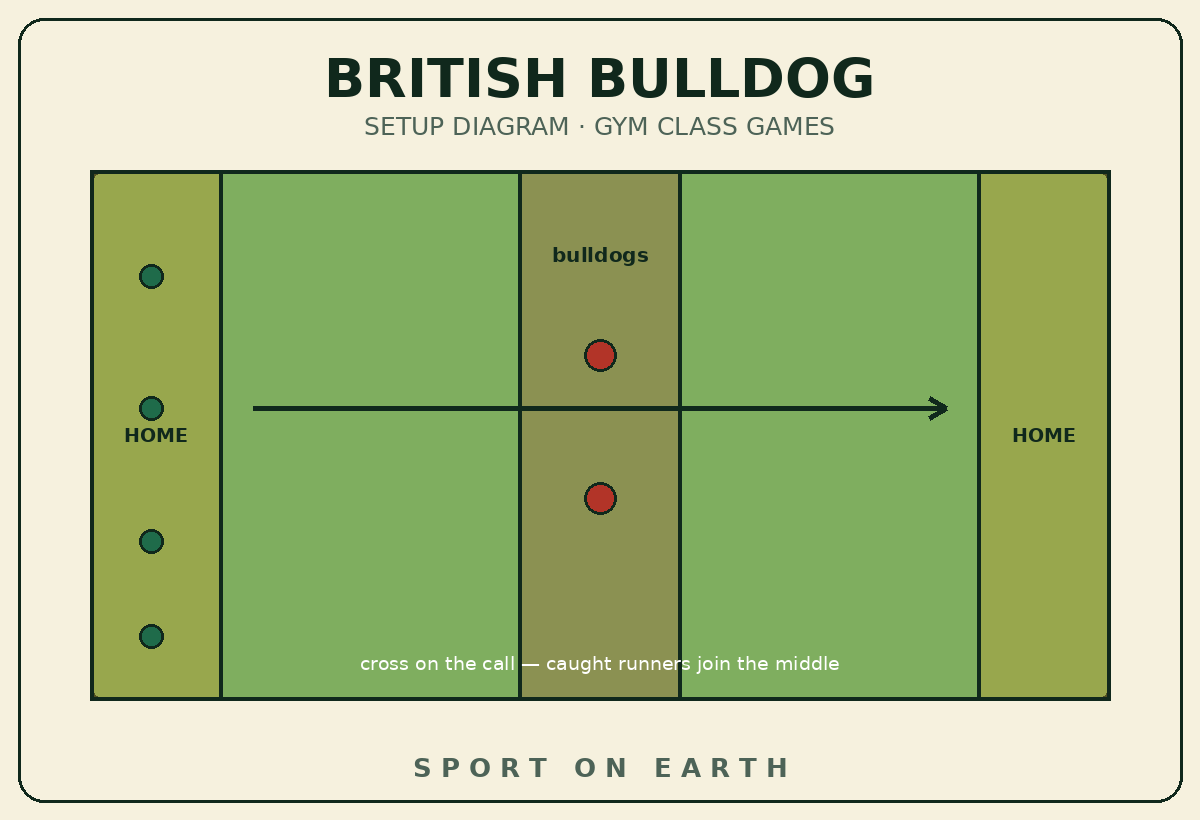
The crossing game of the Commonwealth schoolyard: the whole group lines up at one home end, the bulldogs wait in the middle, and on the call — ’British Bulldog!’ — everyone charges for the far home. Anyone caught joins the bulldogs, so the middle grows and the gaps shrink until one runner is left. The school form played today catches by tag, not by tackle.
At a glance
| Players | 8 or more — one or two bulldogs against the field |
|---|---|
| Equipment | None |
| Space | A field or gym with a safe ’home’ zone at each end and open ground between |
| Family | Tag & chase games |
What it is — and where it comes from
British Bulldog descends from traditional chasing and crossing games recorded in the 18th and 19th centuries — its ancestors include the games called Black Man and Pom-Pom-Pull-Away — and reference histories note it did not emerge under its own name until the 1930s: the Cambridge District Scouts record it practised under that name from that decade, and an early printed source dates to 1 March 1934. The Boy Scouts of America adopted the name, likely during the Second World War.
The game’s physicality is part of its documented record: the traditional catch involved lifting or tackling the runner, which made it a training drill for rugby and football skills — and got it banned from many school playgrounds after injury concerns (the British Medical Journal was discussing it in 1985). The version in this directory is the supervised school form: a catch is a two-handed TAG, never a tackle.
Setup diagram
How to play
Setup
- Mark a home zone at each end of the field. One or two players are the bulldogs and stand in the middle.
- All other players line up in one home zone. Agree the catch rule out loud before starting: TAG ONLY.
Rules
- A bulldog calls a runner by name (classic form) or calls the whole group: on the call, the named player — or everyone — runs for the far home zone.
- Bulldogs catch runners by tagging them (school form). A caught runner becomes a bulldog and joins the middle for the next crossing.
- Runners who reach the far home zone untouched are safe until the next call, when everyone crosses back.
- Bulldogs may not enter the home zones to catch, and runners may not leave the side boundaries — going out of bounds counts as caught.
- Crossings continue until one runner remains uncaught.
Scoring
The last uncaught runner wins and starts the next game as first bulldog. In class form, count crossings survived: the runner who lasts the most rounds wins the session.
Variations
- Named crossings: the bulldog calls one runner at a time — the duel form, and the safest for young players.
- Chain Bulldog: caught runners do not roam free — they link hands with the bulldogs to form a growing chain across the middle.
- Octopus/Seaweed (the Australian cousin): caught players stand where caught and may tag runners within arm’s reach.
Safety
TAG ONLY in the school game — the tackling original is precisely why the game was banned from playgrounds. Soft ground, no diving catches, and stop the crossing if players collide.
Video

Sources
- Wikipedia — ’British bulldog (game)’ (18th–19th-century chasing-game ancestry; name in use from the 1930s; bans)
- Outdoorsy Fun — British Bulldog: history and rules
The how-to-play text above is written in this site's own words from these sources. Where a game's origin is not documented, the history section says so plainly — no origin has been invented for any game in this directory.