Sport on Earth › Games › Gym Class Games › Capture the Flag
Gym Class Games · Field & territory games
Capture the Flag
The great territory game: your flag sits in your half, theirs sits in theirs, and everyone is simultaneously a raider, a guard and a rescuer. Cross the line and you can be tagged and jailed; get their flag back across the line and your team wins. Simple enough for six-year-olds, strategic enough for adults.
At a glance
| Players | Two teams of 6 or more — the bigger the group, the better the game |
|---|---|
| Equipment | Two flags (or bandanas, cones, pool noodles — one per team, visibly different); pinnies help |
| Space | The largest space available, split into two territories by a centre line; a gym works, a field with cover works better |
| Family | Field & territory games |
What it is — and where it comes from
Capture the Flag has a genuinely documented paper trail. Rules for it appear in 1860 in Wilhelm Lübeck’s German gymnastic manual Lehr- und Handbuch der deutschen Turnkunst under the name Fahnenbarlauf, as a form of the older European game Barlaufen. English descriptions followed in the early 20th century: Robert Baden-Powell’s Scouting for Boys (1908) carried it as ’Flag Raiding’, and the Boy Scouts of America’s Official Handbook for Boys (1920) printed it too.
The fullest early rule set is the 1947 Scoutmaster’s Handbook version, still republished by the US Scouting Service Project: territories split by a boundary, flags placed within 200 steps of the start and visible, guards kept 50 feet from their own flag unless an enemy enters the circle, capture by holding a player long enough to say the capture words, and — if no flag falls in the agreed time — victory to the team holding the most prisoners. The jail-and-rescue game played in PE today descends directly from that scouting form.
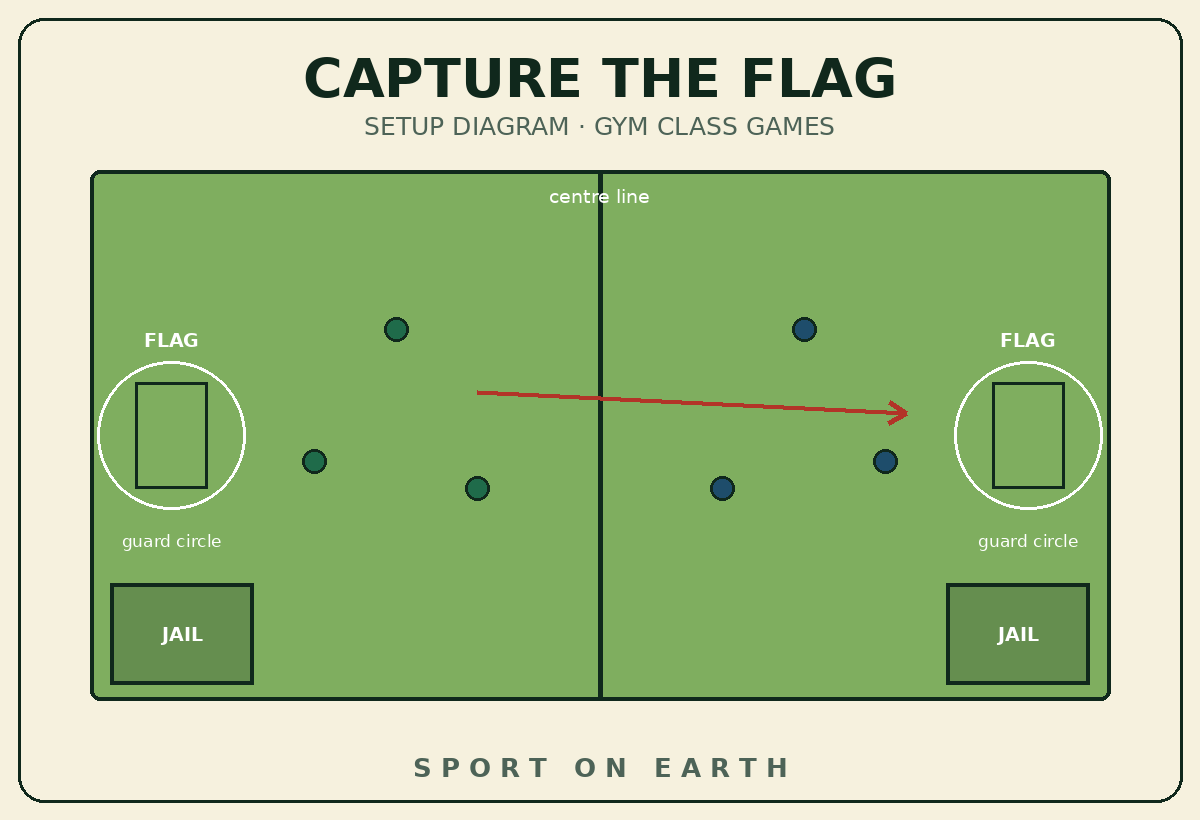
Setup diagram
How to play
Setup
- Divide the space into two territories with a clear centre line. Each team places its flag in its own territory — visible, and (in the classic rule) with a guard-free circle around it.
- Mark a jail in each territory, near the centre line: a small area where captured opponents wait.
- Teams spread between guarding their flag and massing for a raid; agree the time limit and whether a captured flag carrier may pass the flag (classic rule: no — it is carried or dropped).
Rules
- You are safe in your own territory. Cross into the enemy half and any opponent may tag you.
- A tagged player goes to the enemy jail and stays there — classically, prisoners link arms in a chain reaching toward the centre line.
- A free teammate who reaches the jail without being tagged frees the prisoners by touching the chain; freed players walk (not run) back to their own territory — they cannot be tagged on the walk back, and cannot free anyone else on the way.
- Grab the enemy flag and carry it across the centre line into your territory to win. If you are tagged carrying it, the flag returns to its place (or stays where dropped, by house rule) and you go to jail.
- Guards may not camp on top of their own flag: in the classic rule they stay outside its circle unless a raider enters it.
Scoring
First team to bring the enemy flag home wins the game. If the time limit expires first, the classic rule awards the game to the team holding the most prisoners; school games often count successful raids across several short rounds.
Variations
- Two-flag continuous: after a capture, flags reset and play continues; most captures in the time wins.
- Flag football form: tags are replaced by pulling a flag belt — the version many PE programs use to remove contact disputes.
- Hidden flags (night or woods games): flags may be concealed rather than placed visibly, with a smaller playing area.
Safety
Tags are a touch, never a grab, hold or tackle. Keep the jail in sight of the supervising adult, and agree boundaries firmly — most CTF injuries are collisions with the scenery, not the opponents.
Video

Sources
- US Scouting Service Project — Capture the Flag, traditional rules from the 1947 Scoutmaster’s Handbook
- Wikipedia — ’Capture the flag’ (Lübeck 1860; Baden-Powell 1908; BSA Handbook 1920)
The how-to-play text above is written in this site's own words from these sources. Where a game's origin is not documented, the history section says so plainly — no origin has been invented for any game in this directory.