Sport on Earth › Games › Gym Class Games › Castle Ball
Gym Class Games · Target games
Castle Ball
Build a castle out of hula hoops — one flat on the floor, four standing as walls, one on top — then defend it with your bodies while you throw foam balls at the other team’s castle across the centre line. A castle that falls scores for the attackers, gets rebuilt at once, and the game never stops.
At a glance
| Players | Two teams — 3-on-3 up to a whole class in halves (the PE Central lesson is built for small teams) |
|---|---|
| Equipment | Hula hoops (4–6 per castle), one or more soft foam balls (volleyball size, foam — never a regulation volleyball) |
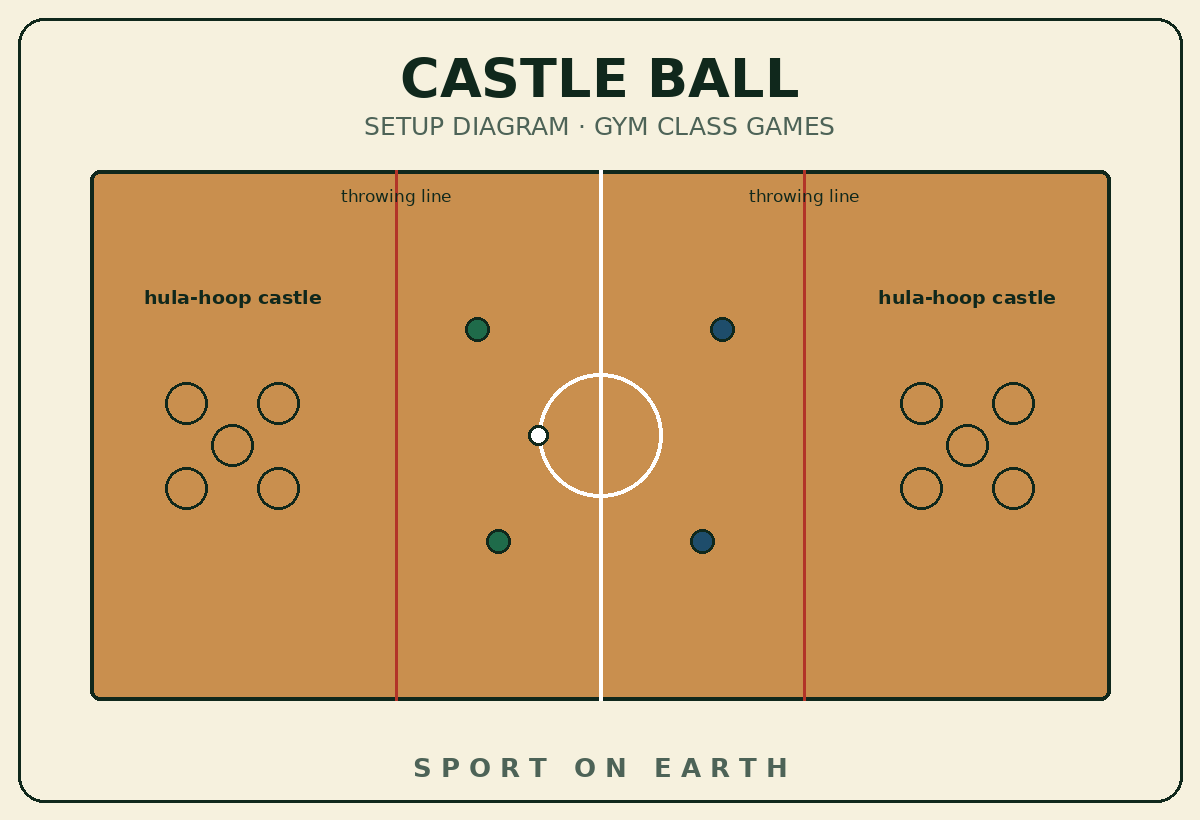
| Space | A gym split by a centre line, with a throwing line marked in each half |
| Family | Target games |
What it is — and where it comes from
Castle Ball is documented as a teacher-shared PE lesson rather than a published commercial game: PE Central, the profession’s lesson-plan exchange, carries the full lesson (’Castle Ball’, submitted by Louis Larouche of Victoria Park School, St-Lambert, Quebec; posted on PE Central in 2019), and Playworks, the school-play organisation, carries the same game in its game library for grades 3–5.
Both sources describe the same construction — a ’house of cards’ of four to six hula hoops — and the same core rule: one point each time a castle is knocked down, even if your own player bumps it. No earlier origin is documented, and none is claimed here.
Setup diagram
How to play
Setup
- Split the gym with a centre line and mark a throwing line inside each half. Teams build their castles at the back of their own half: one hoop flat, four hoops as walls, one on top.
- Each team divides itself into guards (front and back of the castle) and throwers.
- Start with one foam ball per side (more balls for bigger classes).
Rules
- Throw or bowl the ball at the opposing castle from behind your throwing line. No throwing at a castle while it is being rebuilt.
- Players may not cross the centre line, even to retrieve a ball.
- Guards defend the castle by blocking and catching balls with their bodies and hands — they are allowed to be in the ball’s path; throwers aim at the castle, not at the guards.
- A castle knocked down — by a ball, or even by its own team’s player bumping it — scores one point for the opposing team, and is rebuilt immediately so play continues.
- Passing is part of the game: work the ball between throwers to wrong-foot the guards rather than throwing every ball from the same spot.
Scoring
One point per castle knocked down. First to an agreed total, or most points when the lesson time ends. A round can also be declared when all of one team’s castles (in multi-castle games) are down at once.
Variations
- Multi-castle: three castles per team at the back of the half (the school field-day form); the round ends when all three are down.
- Pin castles: build the castle from foam bowling pins instead of hoops (the form in several school PE collections).
- Non-dominant hand only, to level the throwing (suggested in the PE Central lesson).
Safety
Foam balls only, throws at the castle and kept low; the throwing line exists to keep a safe distance between throwers and guards — hold it.
Video

Sources
- PE Central — ’Castle Ball’ lesson plan (Louis Larouche, Victoria Park School, St-Lambert, Quebec)
- Playworks — Game Library: Castle Ball
The how-to-play text above is written in this site's own words from these sources. Where a game's origin is not documented, the history section says so plainly — no origin has been invented for any game in this directory.