Sport on Earth › Games › Gym Class Games › Ga-Ga Ball
Gym Class Games · Dodgeball family
Ga-Ga Ball
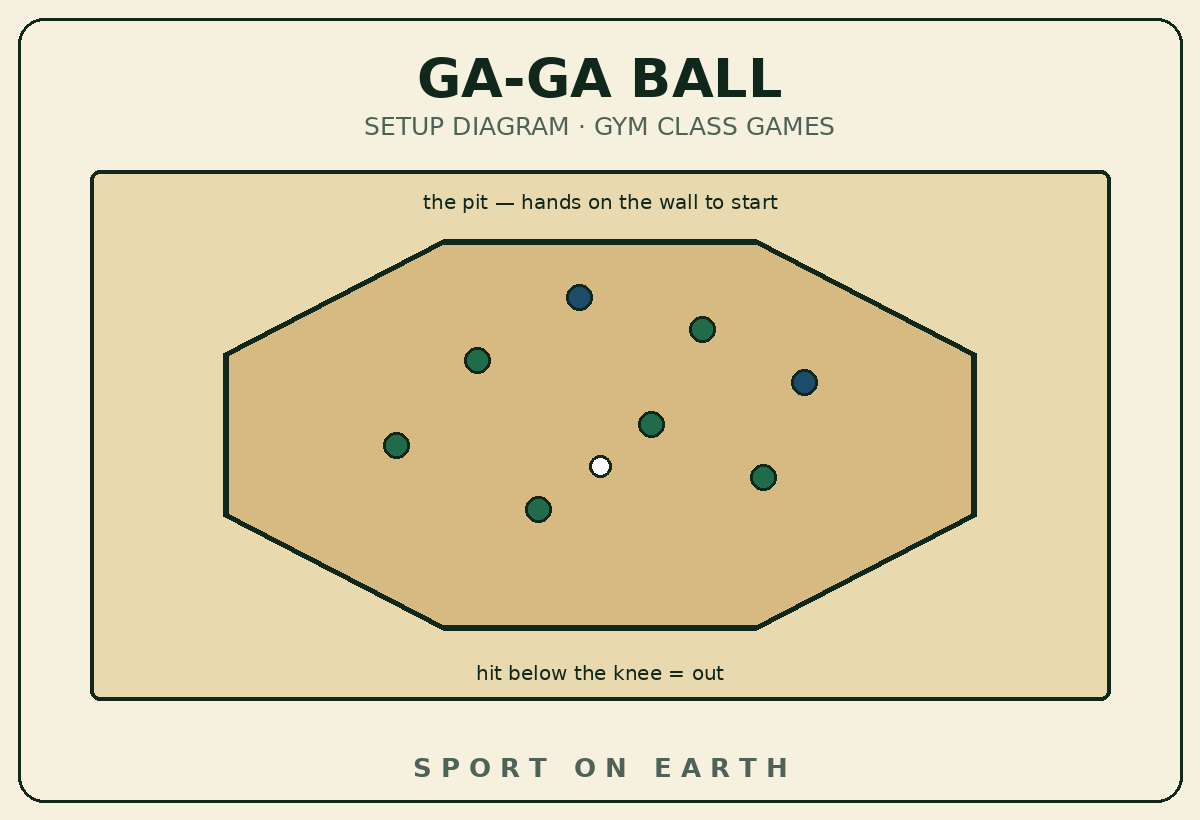
Dodgeball’s kinder, faster cousin, played inside an octagonal pit. You may only strike the ball with your hand — never catch or throw it — and you are out only if it touches you below the knee. Games last minutes, the eliminated climb out, and the next game starts at once.
At a glance
| Players | Everyone in one pit — up to about 15–20 at a time; last player standing wins |
|---|---|
| Equipment | One soft playground ball; a gaga pit (octagonal low-walled enclosure) or any walled corner of a gym |
| Space | An octagonal pit, typically about 6–8 metres across; schools also play in a taped or walled area |
| Family | Dodgeball family |
What it is — and where it comes from
Ga-Ga’s origins are genuinely contested, and the honest account is the contest itself. The predominant theory, recorded in the game’s reference literature, is that it was invented in Israel in the mid-20th century — ’ga-ga’ is Hebrew for ’touch-touch’ — and carried to the United States by Israeli counselors working at Jewish summer camps, arriving in the Northeast as early as the 1950s and spreading nationwide over the following decades.
In 2016–17 Tablet magazine reporter Stephen Silver investigated the competing claims and found a documented alternative: Steve Steinberg, who said he invented the game in 1975 as a teenage counselor at a Jewish Community Center camp near Baltimore, devising a below-the-knee hand-striking game safe for six-year-olds — a claim backed by a 1992 Baltimore Jewish Times article, long before ga-ga became a schoolyard industry. This page reports both accounts rather than picking one.
Setup diagram
How to play
Setup
- All players stand inside the pit with one hand touching the wall.
- A referee (or a player) tosses the ball into the centre of the pit.
- As the ball bounces, the players chant: ’Ga!’ on the first bounce, ’Ga!’ on the second — after the second (in some pits, third) bounce the ball is live.
Rules
- Strike the ball with an open hand or fist toward other players. You may not catch, hold, scoop or throw it.
- A player touched by the ball on or below the knee is out and leaves the pit. It does not matter who struck the ball — even off your own hit.
- You may hit the ball once; you cannot strike it twice in a row until it has touched another player or the wall.
- If the ball flies out of the pit, the last player to touch it is out.
- You may not use the wall to jump, and you must stay in the pit while you are in the game.
- When two or three players remain, a second ball is often added to finish the game.
Scoring
No points: the last player left in the pit wins the game. Winners customarily start the next game or step out to let the line in.
Variations
- Below the waist instead of below the knee (a common school softening).
- Team ga-ga: two halves of the pit, team colours, last team with a player standing wins.
- Wall-ball start: no chant — the ball is live from the referee’s toss.
Safety
The below-the-knee rule is the safety rule: keep strikes low, use a soft ball, and players who are out leave the pit promptly so they are not struck standing still.
Video

Sources
- Wikipedia — ’Gaga (game)’ (origins, Tablet investigation, general rules)
- On Scouting (Scouting Magazine) — ’Who invented ga-ga ball?’ (Tablet/Steinberg account)
The how-to-play text above is written in this site's own words from these sources. Where a game's origin is not documented, the history section says so plainly — no origin has been invented for any game in this directory.