Sport on Earth › Games › Gym Class Games › Kickball
Gym Class Games · Diamond games
Kickball
Baseball rebuilt for the playground: the pitcher rolls a big rubber ball, the ’batter’ kicks it, and fielders can get a runner out by throwing the ball to a base — or, in the schoolyard form, by hitting the runner with the ball below the shoulders. It was invented to teach baseball to children, and it has been PE’s diamond game ever since.
At a glance
| Players | Two teams of 8–15 |
|---|---|
| Equipment | One playground ball (the classic red rubber ball), four bases |
| Space | A baseball diamond or any field marked with home, three bases and a pitching strip |
| Family | Diamond games |
What it is — and where it comes from
Kickball has two documented inventor claims, and both are printed here. The earlier: Dr Emmett Dunn Angell’s 1910 book ’Play’ described ’Kicking Baseball’, with a description and field illustration close to the modern game. The better documented: Nicholas C. Seuss, Supervisor of Cincinnati Park Playgrounds, published ’Kick Base Ball’ in The Playground Book in 1917 — twelve rules and a field diagram.
Its spread is documented precisely: in 1920–21 physical education teachers in US public schools were using ’Kick Ball’ to teach young children the basics of baseball, playing with a soccer ball or volleyball, ten to thirty players, a neutral zone and no pitcher — the ball was kicked from a three-foot circle at home. Pitching, strikes and the full baseball structure were layered in over the following decades; Daniel Chase, New York State’s supervisor of physical education, recorded adults playing it in 1922. In South Korea the same game, balyagu (’foot-baseball’), is a staple of elementary PE.
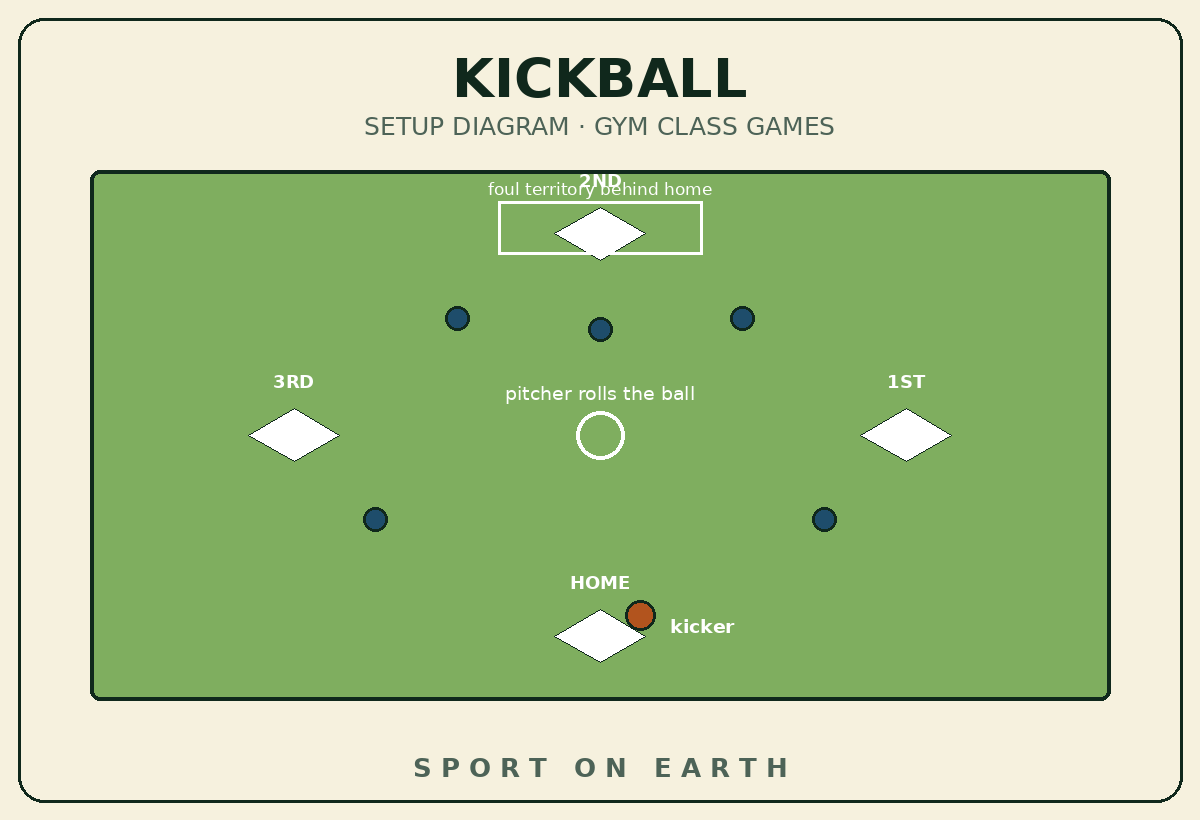
Setup diagram
How to play
Setup
- Mark the diamond: home plate, first, second and third, a pitcher’s strip, and foul lines from home through first and third.
- The kicking team lines up in a set order behind home; the fielding team takes baseball positions, with every fielder except the catcher starting behind the first–third diagonal until the ball is kicked.
Rules
- The pitcher rolls the ball underhand toward home plate; it must arrive bouncing or rolling within reach of the kicker.
- The kicker kicks with the foot or leg below the knee. A kick that crosses the foul line before passing first or third is foul.
- Kickers are out on: three strikes (a swing and a miss, or a pitch taken in the strike zone, per house rules), three fouls in many school versions, a kicked ball caught on the fly, or being hit by a thrown ball below the shoulders while off a base (school form) / a tag or force-out (league form).
- Runners may not lead off or steal; they leave the base when the ball is kicked.
- Three outs, teams swap. A runner who touches all four bases scores one run.
Scoring
One run per completed circuit. Most runs after the agreed innings (five is a common school game) wins; ties stand or are settled by one extra inning.
Variations
- Mat Ball — the indoor, mats-for-bases descendant in this directory.
- No-throw-at-runners (younger classes): outs only by tag, catch or force, as in baseball.
- One-pitch kickball: every kicker gets exactly one pitch — kick it or sit down — which keeps a whole class moving.
Safety
The throw-at-the-runner rule is below the shoulders only and never at the head; many schools ban it outright for younger players. No sliding in the school game.
Video

Sources
- Kickball — history and rules (Angell 1910; Seuss, The Playground Book, 1917; PE use 1920–21)
- Sophomore PE Diamond Sports Study Guide — Kickball & Wiffleball (history and rules)
The how-to-play text above is written in this site's own words from these sources. Where a game's origin is not documented, the history section says so plainly — no origin has been invented for any game in this directory.