Sport on Earth › Games › Gym Class Games › Kick the Can
Gym Class Games · Tag & chase games
Kick the Can
Hide-and-seek with a jailbreak built in. ’It’ guards a can, hunts the hiders, and jails everyone caught — but any hider still free can sneak in, kick the can, and set every prisoner loose at once. It was the game of the Great Depression for the simplest of reasons: the only equipment was rubbish.
At a glance
| Players | 3 or more — one ’it’ against any number of hiders; dozens can play |
|---|---|
| Equipment | One kickable object — traditionally a discarded empty can, sometimes with stones in it for noise |
| Space | An outdoor area full of hiding places, with the can set in one open, visible spot and a ’jail’ beside it |
| Family | Tag & chase games |
What it is — and where it comes from
Kick the Can’s origin is unknown — the reference record says so plainly — but its heyday is documented: it was a popular pick-up game during the Great Depression in the 1930s precisely because it needed no field and no equipment beyond a discarded can. Folklore archives hold the game in players’ own words from that era onward — the James T. Callow Folklore Archive at the University of Detroit Mercy preserves accounts of it played in New York in the 1930s and in Indiana around 1949, complete with the jail beside the can and the cry of ’alle, alle, oxen free’ when the can was kicked.
Its cultural footprint is documented too: the game is central to a 1962 episode of The Twilight Zone (and the 1983 film), and features in the 2010 PBS documentary New York Street Games.
Setup diagram
How to play
Setup
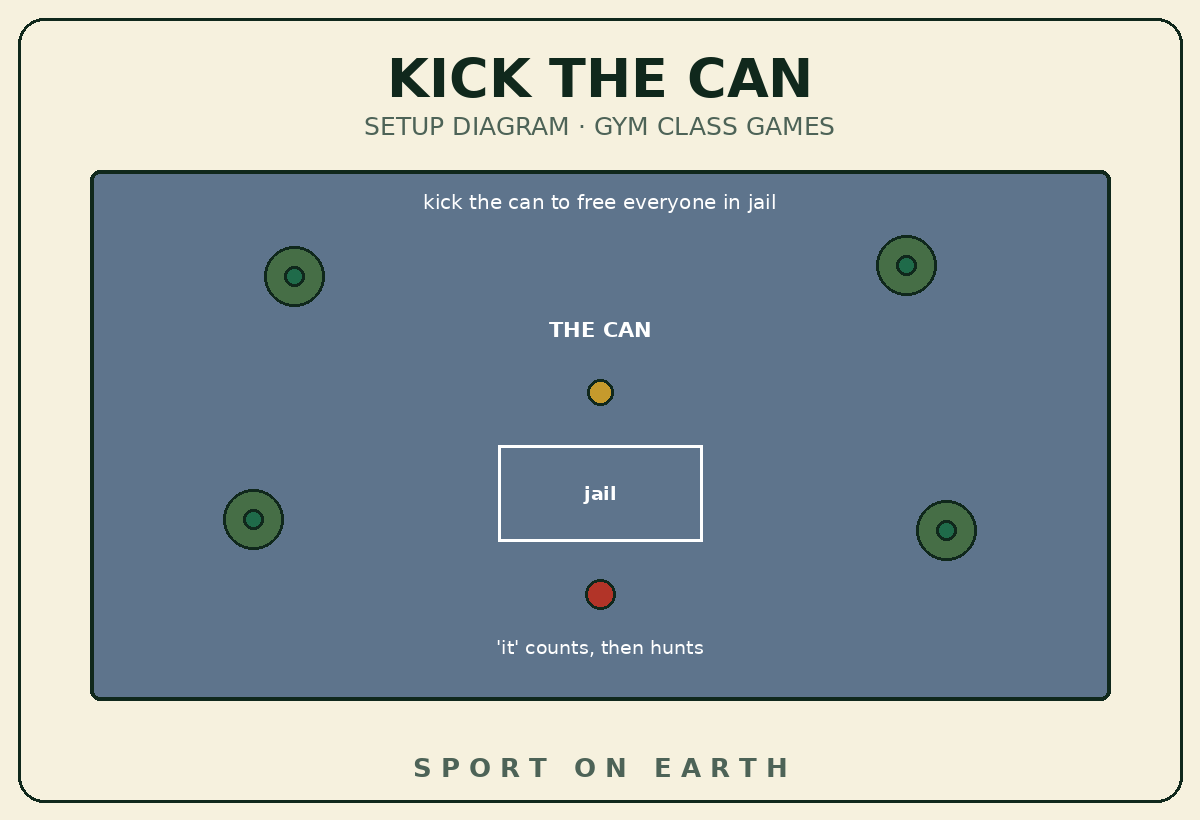
- Place the can in an open, visible spot. Mark the jail — a patch of ground in plain sight of the can.
- Choose ’it’. ’It’ stands by the can, closes their eyes and counts to an agreed number while everyone else hides — or, in the other classic start, a designated player kicks the can as far as possible and ’it’ must fetch and replace it before hunting.
Rules
- ’It’ hunts the hiders. To catch a hider, ’it’ must see them, run back to the can, put a foot on it and call the hider’s name and hiding place (’I see Maya behind the shed!’).
- A caught hider goes to the jail and waits there, in the open.
- If a hider reaches the can and kicks it before ’it’ can complete a call on them, the kick frees ALL prisoners, ’it’ must replace the can, close their eyes and count again while everyone re-hides.
- A hider spotted while sneaking for the can may still win the race: if they kick the can before ’it’ stamps it and names them, the prisoners go free.
- The round ends when every hider is in jail.
Scoring
’It’ wins the round by jailing everyone. The last hider caught (or the hider who freed the jail most often, by house rule) is ’it’ for the next round.
Variations
- Kick-start form: the game opens with the can being kicked away, giving the hiders their hiding time while ’it’ retrieves it.
- Team Kick the Can: two seekers (’its’) for very large groups, with two jails.
- Tin Can Copper: the London form recorded in Norman Douglas’s London Street Games (1916/1931) — the seeker must fetch the thrown tin back backwards, and a hider who steals and throws the tin again frees everyone.
Safety
Play away from roads — the game pulls players across the whole area at a run, often at dusk. The can should be empty, clean and light; a modern soft alternative is a plastic bottle or a foam ball on a cone.
Video

Sources
- Wikipedia — ’Kick the can’ (Depression-era popularity; rules; cultural record)
- James T. Callow Computerized Folklore Archive, University of Detroit Mercy — ’Kick the Can’ accounts, New York 1930s
The how-to-play text above is written in this site's own words from these sources. Where a game's origin is not documented, the history section says so plainly — no origin has been invented for any game in this directory.