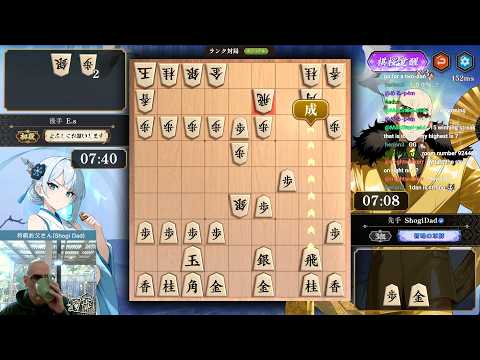
Episode 1 — Fujii defends the Ryuo title in straight games
Ep. 1 — the week of Monday, November 23, 2026 · 0:52
Pages
On this page
Sport on Earth › Sports
Sport on Earth · Sport
Japanese chess on an 81-square board where captured pieces drop back into play as your own.
Sport on Earth’s daily and weekly video shows for Shogi — every episode, newest first.
Ep. 1 — the week of Monday, November 23, 2026 · 0:52
Every embed below was verified playable before listing — the network’s standing rule.
YouTube · Shogi Dad
Pages
On this page
No game on this site is made specifically for Shogi yet. The games below are the site's all-sport games, which honestly cover every sport — nothing from another sport has been dressed up as this sport's game.
A new set of questions every day, across every sport this site covers.
Real-athlete Top Sport on Earth decks built from the site’s verified board data.
Shogi's lab is the Physics Lab section on this page — the applied physics of its sport family, with a computed interactive where one honestly fits.
Physics Arena — the general biomechanics & physics teaching sandbox, shared by every sport.
The homepage sport explorer also carries a general Lab tab of small interactive experiments.
Calendar data not yet carried for Shogi — this site does not yet hold schedule data for it, so no dates are shown rather than invented.
Which section of this page should we expand first?
Votes are counted on the Sport on Earth server and the totals shown are every reader’s votes; your own choice is remembered in this browser.
Sport on Earth does not yet hold verified dated events for Shogi, and its carried record does not state the season's timing in words — so no calendar is shown rather than an invented one. What the site does carry for this sport is on this page: its verified record, its rules record and its history.
Mind sports have no projectile to model — honestly, a calculator would be decoration. Their measurable physical quantities are human: reaction times of roughly 150–250 milliseconds set the floor for esports actions; sustained calculation burns real metabolic energy (elite chess players’ heart rates and stress hormones during long games are documented in the sports-science literature); and the clock converts thinking itself into a resource with a hard physical limit.
The applicable science is information theory and decision science: a position’s complexity can be counted (legal moves, game-tree size), engines measure evaluation in centipawns (hundredths of a pawn), and time trouble is simply the point where required calculation exceeds available seconds. Sport on Earth’s lab for this family is therefore an explainer, with the honest note that no honest calculator fits.
From this sport's own record: Japanese chess on an 81-square board where captured pieces drop back into play as your own. The lab above treats the physics of the sport's family; no measurement specific to this sport is printed, because the site's verified record for it carries none — parameters are never invented to fill a lab.
No calculator is offered for this sport — honestly, none fits without inventing parameters. The site's general Physics Arena remains the hands-on sandbox, with every formula printed.
The general teaching sandbox for every sport is the Physics Arena on the Games page — the same printed models, with a defender added.
The hands-on lab for Shogi, built entirely from the record this site carries for it — its documented rolls, its halls, its venues, its calendar and its census family. Every figure below is computed from that carried record at build time; nothing is estimated and nothing is pulled live. The companion Physics Lab on this page works the family's physics; this lab works the record.
The honest position: the record this site carries for Shogi is thin — no documented roll, hall, venue set or dated calendar is carried for it yet — so this entry’s lab is its family lab: the computed census of the family it belongs to. When the record grows, the lab grows with it; nothing here is estimated to fill the space.
Computed from the site census: the Mind sports family holds 23 entries on this site. Across the family, the carried record includes documented rolls for 1 of them, Hall of Fame data for 2, venue sets for 1, and dated calendars for 0.
Every other entry in the family: Backgammon · Bashi · Bridge · Chess · Crocker · Dominoes · Draughts · Esports · Fantasy Sports · Go · Janggi · Jeu de Main · Lexicon & Coordinate Quizzes · Mahjong · Oware · Pachisi / Ludo · Pärk · RoboCup · Scrabble · Slahal · Subbuteo · Xiangqi
Basis: the Sport on Earth census itself — the same 460-entry register the census page prints.
The desk has not verified a sponsorship record for Shogi from published sources, so none is printed. Sponsorship history is added only when a real published source supports it — sponsor by sponsor, deal by deal. Current sponsorship deals across sport are tracked on the Money Desk sponsorship page.
How this game is played, gathered from the record Sport on Earth already carries for Shogi, with the positions taken from the sourced chart cited in that section.
Shogi, also known as Japanese chess, is an abstract strategy board game for two players and one of the most popular board games in Japan, in the same family as Western chess, chaturanga, xiangqi, Indian chess, makruk and janggi. Its distinctive feature is the drop rule: captured pieces are kept ’in hand’ and can be dropped back onto the board on a future turn, a mechanic shogi was the earliest historical chess-like game to use.
Standard shogi is played on a 9×9 board of 81 squares with 40 pieces, 20 per player, and games usually end in checkmate, with draws occurring in only about 2–3% of professional games. Its professional top level is organised by the Japan Shogi Association, the only body that can organise professional tournaments, including the eight major title championships known as the 8 Crowns.
The rules — the rules as this site's record carries them:
Shogi has no fixed positions — its format designates no positional roles.
Format as carried in hidden_files/batchB-nov1/batchb_data.json: "Japanese chess on an 81-square board where captured pieces drop back into play as your own." The format carries no designated positional roles. (Source: Sport on Earth carried sport record.)
Its Tactics & Strategy book — its opening entries, the basic plays, are:
The full book carries 10 entries — in this page’s Playbook / Tactics & Strategy section, and at the Playbooks hub.
Sport on Earth's own analytics: every figure in this panel is computed at build time from the record this site itself carries, with the source named. No outside data is used, and no betting figures of any kind.
Census arithmetic: Shogi sits in the mind games family — 22 census sports, of which 1 carry a qualifying champions roll in the site's record.
The carried record for Shogi is too thin for computed panels: no champions roll, hall-of-fame list or venue record is carried for it. This panel therefore prints the census arithmetic only — the honest answer rather than a manufactured figure.
Shogi, also known as Japanese chess, is an abstract strategy board game for two players and one of the most popular board games in Japan, in the same family as Western chess, chaturanga, xiangqi, Indian chess, makruk and janggi. Its distinctive feature is the drop rule: captured pieces are kept ’in hand’ and can be dropped back onto the board on a future turn, a mechanic shogi was the earliest historical chess-like game to use.
Standard shogi is played on a 9×9 board of 81 squares with 40 pieces, 20 per player, and games usually end in checkmate, with draws occurring in only about 2–3% of professional games. Its professional top level is organised by the Japan Shogi Association, the only body that can organise professional tournaments, including the eight major title championships known as the 8 Crowns.
The Japan Shogi Association (JSA) is the only body which can organize tournaments for professionals.
The eight major professional championship titles, the ’8 Crowns’, are the Meijin, Ryūō, Ōshō, Ōza, Kisei, Kiō, Eiō and one further title listed on the page.
In 1996, Yoshiharu Habu became the first person to hold seven major titles at the same time.
In 2023, Sōta Fujii became the first player to hold all eight major titles at the same time.
Professional ranks run from 4 dan to 9 dan for formal professionals, after the apprentice professional system.
Shogi has no structured results feed this site can carry, so this page is the verified record only — the Japan Shogi Association, its eight major titles and rules as verified in November 2026 — with no live results.
Sources, verified November 1, 2026: Shogi
Material from Wikipedia linked above is used under CC BY-SA 4.0.
How the laws of Shogi are governed today — the documented record, stated plainly.
Shogi’s professional game is governed by the Japan Shogi Association, whose Game Regulations — restated at the General Meeting of Professional Players in 2024 on the page’s account — codify infractions and title play. Its core laws, above all the drop rule in place since the game’s present form emerged, have been refined rather than replaced at dated landmarks. No major dated rule change is carried for shogi.
That framework summary is the whole documented record Sport on Earth can verify for this sport — no major dated rule changes are carried, rather than invent any.
Source basis: The governing body’s published framework as summarised in this section (see the framework text).
Sport on Earth carries no results feed for Shogi: no scores or fixtures are published here, rather than inventing them. The sport's documented record is in its history page and the History & Records section of this page.
The historical record for Shogi — past standings, champions, title history and all-time leaders, as deep as verifiable public records go.
Season-by-season standings, historical player statistics and title rolls are not carried for Shogi: no public archive publishes them in a form Sport on Earth can verify, and this site does not invent history. What is carried for this sport is its verified record, its rule-change history and its league history — elsewhere on this page.
The review and analysis videos from Shogi’s verified video pool — every embed below was identity-checked and probed playable before listing, the site’s standing rule. Nothing here is a show Sport on Earth produces; these are the review, post-game and breakdown videos the pool already carries for this sport.
No verified review-show video is carried for this sport yet.
The filter sorts the Review Room embeds and the picture cards above by the keywords in their carried titles (review / analysis / recap and similar, or highlights). It runs entirely in your browser — nothing is sent anywhere.
No hall of fame with a published inductee list is carried for Shogi. Sport on Earth does not invent halls or inductees: where a recognised hall publishes its list in a form this site can carry, the full list will appear here with its source named.
Japanese chess on an 81-square board where captured pieces drop back into play as your own.
The format, from this sport's verified record:
The Shogi record book is still thin: beyond the standings, rules and calendar layers on this page, no verified winners roll or honours list is carried yet. The desk adds record material only when a published source can be named for it — never from memory or invention.
More from the desk: the expert guide to Shogi · the site-wide Writing Desk · every sport on Earth.
📖 Shogi — Tactics & Strategy — every entry, plus the arcade strategy, at the foot of this page.
An arcade take on Shogi: set the angle, set the power, and land the practice pod in the far marker. Five attempts; the closer to the middle, the more it scores. Arcade distances and a training arc — a game in the spirit of the sport, not a simulation of it. Shogi has no thrown object of its own, so the pod stands in — the launch, the arc and the landing are the game.
This page’s own game is the arcade above. Everything else on the site that fits this sport is listed here — and anything borrowed from a similar sport is labelled as that sport’s game, never passed off as this one’s.
The tools on this site that honestly run on Shogi — its own record first, then the site-wide general tools that apply. The full Shogi toolkit prints the ones that do not apply, with the data reason why.
No bench tool yet computes from Shogi’s own carried record — the general tools below are the ones that honestly apply.
Site-wide tools, not built for Shogi alone: Tournament Planner · My Notebook · The Labs · Design Studio · The Makers’ Bench · Match Day Desk · Play It Near You · Myth-Check Desk · Governing Bodies · Game Clock & Timer · Custom Rulebook Generator · Scout Notes Parser.
Tactics & Strategy — this sport’s book
shogi’s book is its castle formations and opening systems — in a game where captured pieces return as drops, the king’s fortress and the attack’s speed are the whole argument.
10 entries, plus the arcade strategy below. All wording is original coaching-vocabulary prose; nothing is copied from any proprietary playbook.
The king shelters behind a wall of three generals — gold, silver and gold in the Mino shape — cheap to build, quick to defend, the castle of a thousand amateur games and plenty of professional ones.
When it’s used: The default fortress for ranging-rook openings: built in a handful of moves.
The sequence
Classic · the fortress
The strongest famous castle: a tower of golds and silvers that takes many moves to build and anchors the double static-rook opening that shares its name — shogi’s classical main line.
When it’s used: The Yagura game is shogi’s Ruy Lopez: the deepest theory in the game grows from it.
The sequence
The king is buried in the corner’s deepest square, walled by generals on every side — the most solid castle in shogi, bought with the whole opening’s tempo.
When it’s used: When survival is the whole plan: an Anaguma king is nearly unmateable, if the game lasts long enough to finish building it.
The sequence
Shogi’s openings divide by the rook’s home: static rook keeps it on its file and attacks up the board; ranging rook swings it to the left half to attack sideways. Castles, theory and temperament all follow the choice.
When it’s used: The game’s founding decision — every opening name in the book hangs from it.
The sequence
The bishops are traded off the board in the opening’s first moves — and immediately become drop threats in both players’ hands: the opening that teaches shogi’s drop rule fastest.
When it’s used: A whole opening family built on the game’s signature rule: nothing captured is ever gone.
The sequence
The silver general marches up the board’s flank in a zigzag, straight at the enemy camp: the ’rushing silver’ is an attack that walks, trading the piece’s defence for a spearhead.
When it’s used: The standard attacking pattern against castles: the silver is the battering ram’s head.
The sequence
Attacking down the board’s edge file, where the king’s castles are thinnest at their corners — many mates begin by prising the edge pawn and dropping pieces into the wound.
When it’s used: Castles are strong in front and soft at the corners; the edge attack is aimed at the softness.
The sequence
Shogi’s tactical vocabulary turns on drops: a bishop dropped at a fork of king and rook, a pawn dropped to smother, a gold dropped as both shield and spear. The hand is a second army; tesuji are how it deploys.
When it’s used: Every captured piece is a future tesuji; the craft is spending the hand at maximum embarrassment.
The sequence
Shogi endgames are races: both kings are attacked at once, and the count is of moves-to-mate, not material. Defence is attack delivered faster; a checking sequence that is one tempo slow is a loss with extra moves.
When it’s used: The game’s famous brutality: shogi games almost never draw, because the race always resolves.
The sequence
A king that storms into the enemy camp and becomes nearly impossible to mate can claim the game by declaration if it gathers enough points — the rule that turns the boldest endgame run in any chess variant into a winning plan.
When it’s used: The rarest winning method in the family: the king wins by going on the attack himself.
The sequence
The arcade cell · strategy
This page’s arcade cell: launch the practice pod at the far marker from across the board · 40 m (arcade scale). Angle, power, launch — five attempts, and the cell keeps your best.
When it’s used: On this page, in the Play section — and its strategy is the same craft as the book above it, miniaturised.
The sequence
Part of the Sport on Earth Playbooks — a book for every sport and every game on the site.
Behind the Play · Full treatment — from this sport’s own record
Japanese chess on an 81-square board where captured pieces drop back into play as your own.
Behind the Play takes the decisive actions of Shogi apart: how the scoring play is built, which patterns the players are really running, and which rules remade the play into its modern shape.
The format, from this sport's verified record:
Source basis: this sport’s carried record on this page (verified record, rule-changes dossier, history datasets) and the play patterns of its family as written in the site’s guides. Nothing here is invented.