Sport on Earth › Games › Gym Class Games › Benchball
Gym Class Games · Wall & court games
Benchball
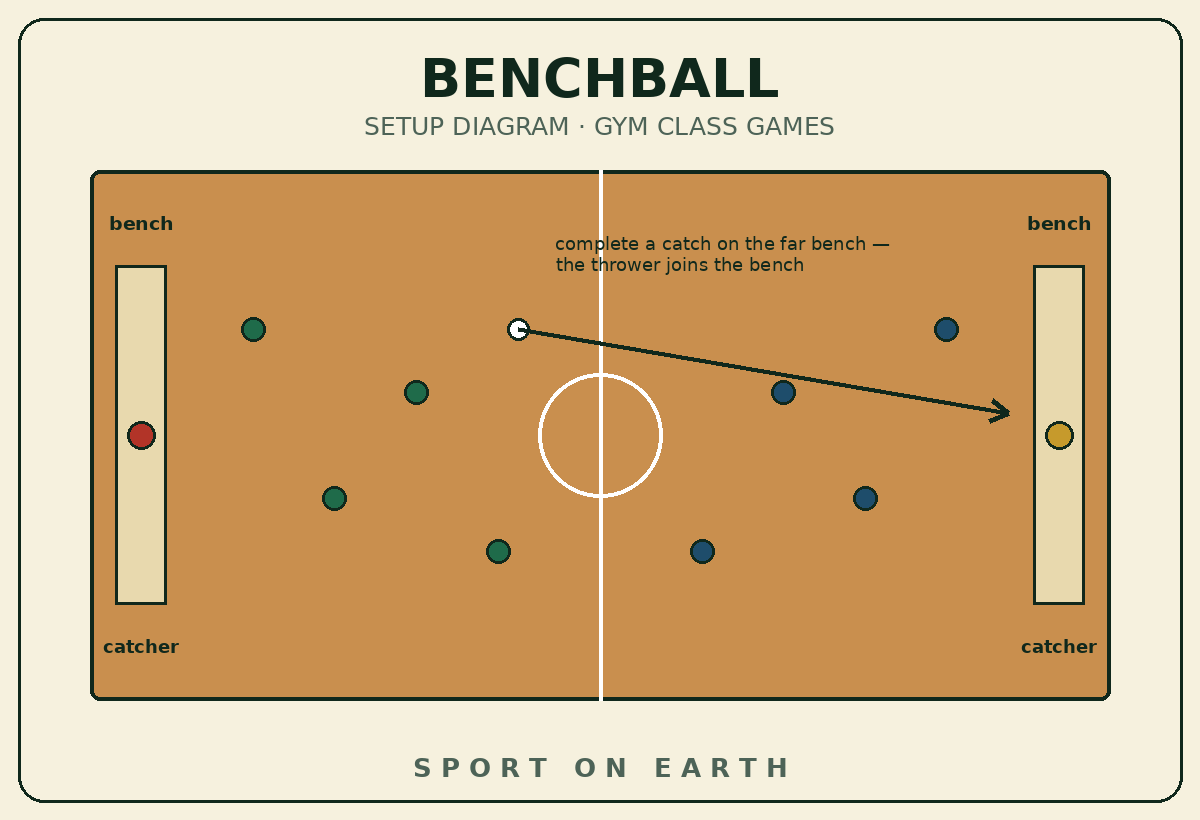
The British school-hall game of throwing your whole team across the court. One of your players starts standing on the far bench as your catcher; complete a pass to them and YOU join the bench. First team to get everyone onto the far bench wins — while the other team intercepts everything it can.
At a glance
| Players | Two teams of 4–12 |
|---|---|
| Equipment | One soft ball (more in the dodgeball-style form), two gym benches |
| Space | A court with a bench at each end, inside the playing area |
| Family | Wall & court games |
What it is — and where it comes from
Benchball is documented as a British school and university game with, in the reference record’s own words, no agreed standard: it is played informally in schools and semi-competitively in UK universities, is commonly used by PE teachers to introduce ball handling and spatial awareness (and as a wet-weather substitute activity), and its rules have traditionally spread by word of mouth — which is why several distinct competitive forms (netball-style, dodgeball-style, five-pass, rugby-style) all carry the same name.
No inventor or founding date is documented; the game’s modern record is its university competition scene and its place in UK primary PE resources such as Playworks’ game library and Primary Resources’ PE collection.
Setup diagram
How to play
Setup
- Place a bench at each end of the court. Each team starts in its own half; one player from each team — the first catcher — stands on the bench at the OPPOSITE end.
- Start with the ball thrown up at centre (netball form) or with several balls on the centre line (dodgeball form).
Rules
- Move the ball by passing. In the netball form, a player holding the ball may not travel with it — pivot and pass, as in netball; in the dodgeball form players may move with the ball but must stay in their own half.
- Score by completing a pass to your catcher on the far bench, caught cleanly while the catcher stays on the bench (at least one foot on it).
- When your pass is caught on the bench, YOU run and join the bench — the team on the bench grows by one with every score, and the bench players become catchers too.
- An interception turns possession over; a dropped or fumbled pass is a loose ball that either team may pick up (netball form: a dropped catch usually turns the ball over — agree before play).
- Defenders may intercept in the air but may not snatch the ball from a player’s hands or make contact.
Scoring
Each completed bench catch moves one player onto the bench. The game is won when a team has its whole team on the far bench except one player (six scores for a team of seven, in the university netball form); in timed school games, the team with more players on the bench when time ends wins.
Variations
- Five-pass Benchball: exactly five passes must be completed before the bench pass may be attempted.
- Dodgeball-style (Sheffield) Benchball: multiple balls, players stay in their own half, and bench catches are made against live defensive pressure.
- Benchball (thephysicaleducator.com form): a different game with the same name — teams score by KICKING a ball against the face of the opponents’ tipped-over bench, no hands allowed.
Safety
Benches must be stable and against the wall line; catchers keep one foot planted on the bench, nobody climbs or jumps from it, and throws to the bench are passes, not shots.
Video

Sources
- Wikipedia — ’Benchball’ (UK school/university game; no agreed standard; rule variations)
- GamesRules.net — How to Play Bench Ball (court setup, transfer rules, history note)
The how-to-play text above is written in this site's own words from these sources. Where a game's origin is not documented, the history section says so plainly — no origin has been invented for any game in this directory.