Sport on Earth › Games › Gym Class Games › Tetherball
Gym Class Games · Wall & court games
Tetherball
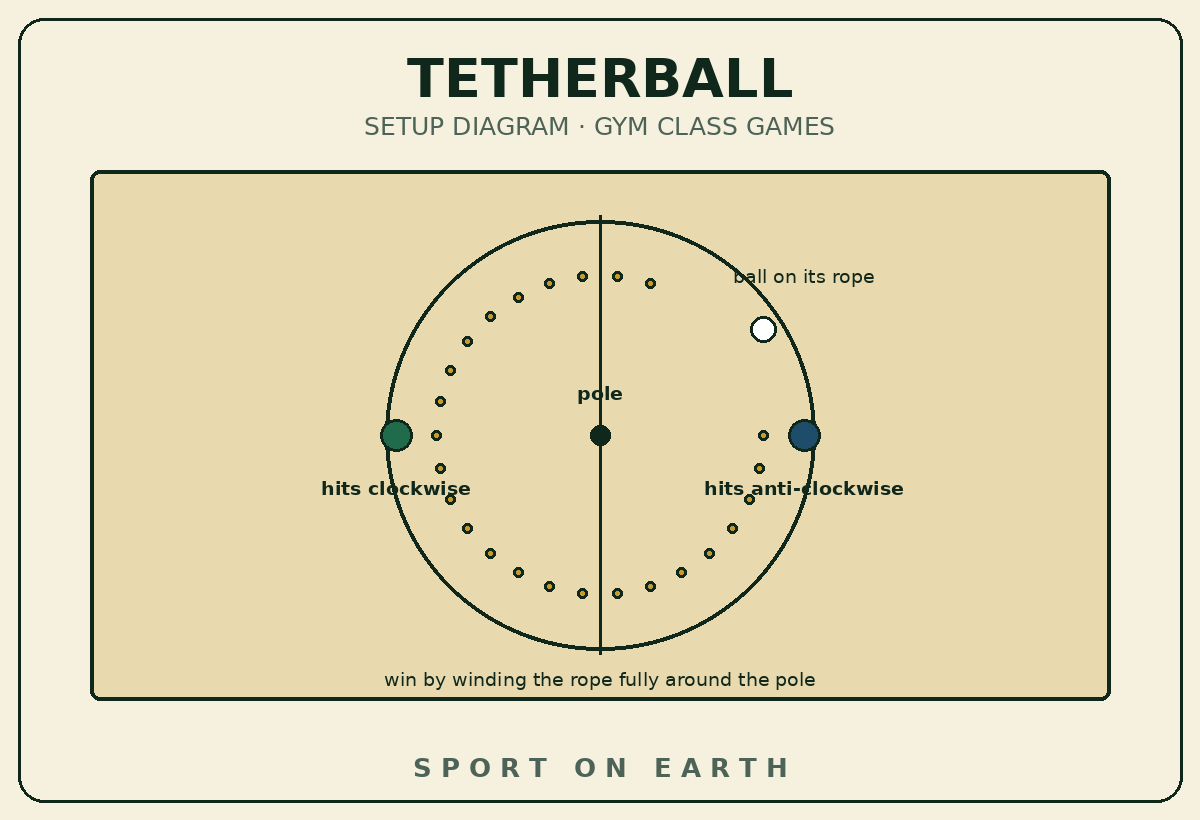
A ball on a rope, a pole, and two players hitting in opposite directions. One of you is winding the rope clockwise around the pole, the other anti-clockwise; the game ends the moment the rope is fully wound and the ball slaps against the pole in somebody’s direction. Two minutes a game, winner stays on.
At a glance
| Players | 2 on court, winner stays on; a line of challengers rotates in |
|---|---|
| Equipment | A fixed pole about 10 feet high, a rope, and a tetherball (volleyball-sized, softer than a volleyball) |
| Space | A circle around the pole — about 20 feet across — split into two halves, one per player |
| Family | Wall & court games |
What it is — and where it comes from
Tetherball’s early form is documented in a named book: Jessie H. Bancroft’s Games for the Playground (1909) describes a tethered tennis ball struck with racquets — the game also known as swingball or tether tennis. The volleyball version could only follow the invention of volleyball itself (1895), and the reference record notes that in the 1920s schools and parks began adding tetherball poles to their play areas — which is where it has lived ever since.
The inventor of the hand-struck game is not documented, and claims of much older origins are not supported by the record; this page prints the documented version: a racquet game in 1909, a schoolyard fixture by the 1920s.
Setup diagram
How to play
Setup
- The court is the circle around the pole, divided into two halves. Each player stays in their own half for the whole game.
- Decide the winning height line on the pole (about five feet up is standard; lower for younger players).
- The server starts by holding the ball in one hand and striking it with the other, in either direction — that direction becomes the server’s winding direction.
Rules
- Players strike the ball with the hand (open hand or fist) so it travels around the pole; each player always hits in their own winding direction, opposite to the opponent’s.
- You may only strike the ball after it has either circled the pole or been struck by your opponent — no double-hitting your own shot back into play.
- Fouls: stepping into the opponent’s half, touching the rope instead of the ball, striking the pole, catching or holding the ball, or hitting it before it has circled or been returned. A foul loses the game in strict rules, or costs the serve in friendly ones.
- The rope must wind in one direction at a time; a hit that unwinds the opponent’s progress is the heart of the game.
Scoring
A game is won by winding the rope completely around the pole in your direction so the ball strikes the pole above the height line. Matches are usually best of three games; the winner stays on to face the next challenger.
Variations
- Racquet tetherball (swingball): the 1909 form — a smaller ball, struck with racquets or bats.
- No-foul playground form: fouls simply return the serve to the opponent.
- Around-the-pole rotation: three players, rotating halves after each game.
Safety
Stand clear of the rope’s full swing on the serve, and use a proper soft tetherball — a fully inflated volleyball stings hands and faces.
Video

Sources
The how-to-play text above is written in this site's own words from these sources. Where a game's origin is not documented, the history section says so plainly — no origin has been invented for any game in this directory.