Sport on Earth › Games › Gym Class Games › Wall Ball
Gym Class Games · Wall & court games
Wall Ball
Two players, one wall, one bouncing ball. Wall Ball is the simplest striking game in the gym-class canon: serve the ball so it bounces once on the ground, strikes the wall, and comes back in play — and make the return awkward enough that the other player cannot do the same to you.
At a glance
| Players | 2 on court, plus a line of waiting players (2–10+) |
|---|---|
| Equipment | One playground ball (a red rubber ball is the classic); a flat wall; chalk or tape for the fault line |
| Space | A wall with a clear flat area in front of it — a schoolyard wall or one end of a gym |
| Family | Wall & court games |
What it is — and where it comes from
Wall Ball’s origin is not documented — no inventor, founding school or first rulebook is on record, and this page does not invent one. What is documented is the game itself, in detail, from the children who play it: the University of Melbourne’s Childhood, Tradition and Change project recorded wall-ball rules from Australian schoolchildren (players strike the ball with the hand against the wall in turn; miss the wall and you are out), and school rule sheets in the United States — Fammatre Elementary School in California publishes a full set — describe the same ground-wall-ground pattern, the same fouls (two bounces, out of bounds, failing to return) and the same prize: the winner serves the next game.
That two continents of schoolchildren describe near-identical rules for a game nobody formally published is the honest history of most playground games: they travel child to child, not book to book. Local rule sets differ — some schools play the throw-and-catch version, some allow only a closed fist, some run a points game — which is why every wall has its own house rules and why they are agreed before the first serve.
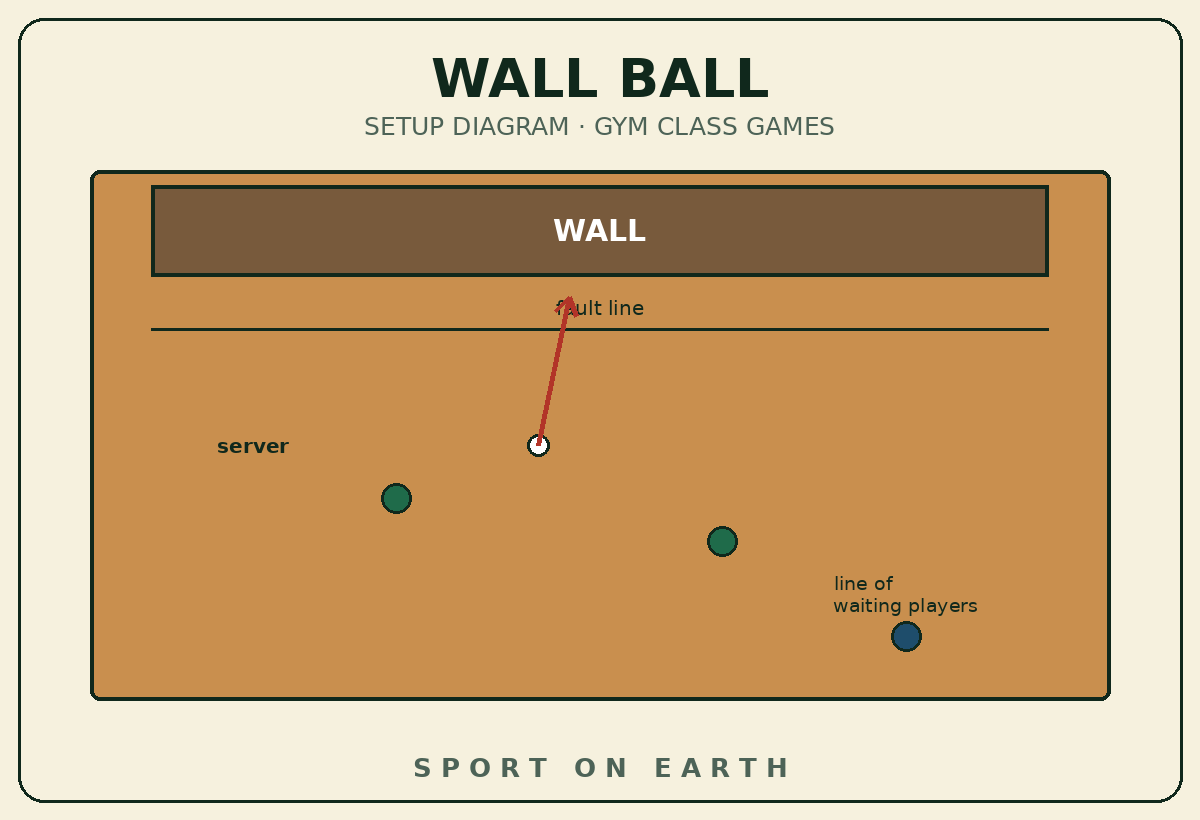
Setup diagram
How to play
Setup
- Mark a fault line on the ground parallel to the wall (schools use the lines already painted, or tape). The court is the ground between the fault line and the agreed side boundaries.
- Two players start on court; everyone else lines up behind the court in order.
- The server holds the ball behind the fault line and starts the game.
Rules
- The server strikes the ball with the hand so that it bounces once on the ground and then hits the wall.
- After the ball comes off the wall it must bounce once on the ground, and the other player must strike it — again ground, then wall — before it bounces a second time.
- Players alternate returns for as long as the rally lasts; each return must follow the same pattern: one bounce, wall, one bounce.
- A player is out for: missing the wall, letting the ball bounce twice (or not at all) before striking it, hitting the ball out of the court, or failing to return it.
- The player who is out goes to the back of the line; the next player in line steps in, and the winner of the rally serves the next game.
- House rules are called before play: open hand or fist, whether a ball that skims the wall (’scrapie’) counts, and whether the throw-and-catch version is being played instead.
Scoring
In the standard playground form there is no running score: winning a rally keeps you on court, and the standing achievement is staying on — after two wins in a row, some schools send the winner to the back of the line so two new players get the court.
Points version: a player scores a point each time the opponent faults; first to an agreed total (11 is common) wins the game.
Variations
- Throw-and-catch Wall Ball: players throw the ball against the wall and anyone may catch the rebound; a dropped catch sends that player sprinting to touch the wall before someone else throws the ball against it — fail, and you take a strike; three strikes and you are out.
- Fist only: returns must be struck with a closed fist (both hands together count as one fist).
- Around the wall: three or more players in rotation, each returner playing the previous player’s rebound.
Safety
Use a playground ball, not a hard ball, where younger players are involved, and keep the waiting line well behind the court so returners are not backing into it.
Video

Sources
- Fammatre Elementary School (Cambrian School District) — Wall Ball playground rules
- University of Melbourne, Childhood, Tradition and Change database — ’Wall ball’
The how-to-play text above is written in this site's own words from these sources. Where a game's origin is not documented, the history section says so plainly — no origin has been invented for any game in this directory.