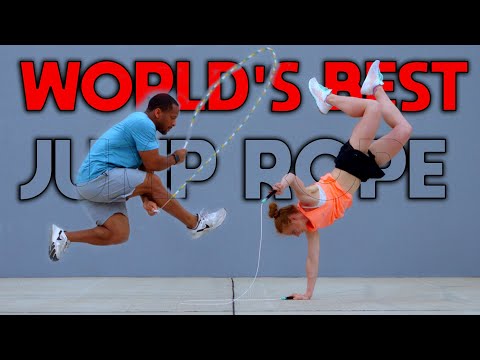
WORLD’S BEST Jump Roping Couple (Slow Motion)
YouTube · Beyond Slow Motion
Pages
On this page
Sport on Earth › Sports
Sport on Earth · Sport
Athletes compete in freestyle routines and timed speed events, jumping a rope swung underfoot and overhead, under the IJRU.
Every embed below was verified playable before listing — the network’s standing rule.
YouTube · Beyond Slow Motion
YouTube · Fight Hub TV
Pages
On this page
No game on this site is made specifically for Jump Rope yet. The games below are the site's all-sport games, which honestly cover every sport — nothing from another sport has been dressed up as this sport's game.
A new set of questions every day, across every sport this site covers.
Real-athlete Top Sport on Earth decks built from the site’s verified board data.
Jump Rope's lab is the Physics Lab section on this page — the applied physics of its sport family, with a computed interactive where one honestly fits.
Physics Arena — the general biomechanics & physics teaching sandbox, shared by every sport.
The homepage sport explorer also carries a general Lab tab of small interactive experiments.
Calendar data not yet carried for Jump Rope — this site does not yet hold schedule data for it, so no dates are shown rather than invented.
Which section of this page should we expand first?
Votes are counted on the Sport on Earth server and the totals shown are every reader’s votes; your own choice is remembered in this browser.
Sport on Earth does not yet hold verified dated events for Jump Rope, and its carried record does not state the season's timing in words — so no calendar is shown rather than an invented one. What the site does carry for this sport is on this page: its verified record, its rules record and its history.
Above modest speeds, air resistance is the main cost of endurance sport: drag force grows with the square of speed, and the power to overcome it with the cube — doubling speed takes roughly eight times the power against the air. The calculator below shows drag and power against speed for air and water with the model’s assumptions printed (standard densities, a fixed drag-area you set).
In water the same equation bites a thousand times harder per unit speed because water is about 800 times denser than air — which is why streamlining, not strength, is the first skill of swimming, and why drafting behind another athlete is worth so much in both media.
From this sport's own record: Athletes compete in freestyle routines and timed speed events, jumping a rope swung underfoot and overhead, under the IJRU. The lab above treats the physics of the sport's family; no measurement specific to this sport is printed, because the site's verified record for it carries none — parameters are never invented to fill a lab.
Model: drag force F = ½·ρ·CdA·v²; power against drag P = F·v. Assumptions: constant drag area, no waves, no rolling or internal resistance — drag only. CdA is the athlete-and-equipment drag area: a tucked cyclist is roughly 0.2–0.3 m²; treat other values as exploration, not measurement.
The general teaching sandbox for every sport is the Physics Arena on the Games page — the same printed models, with a defender added.
The hands-on lab for Jump Rope, built entirely from the record this site carries for it — its documented rolls, its halls, its venues, its calendar and its census family. Every figure below is computed from that carried record at build time; nothing is estimated and nothing is pulled live. The companion Physics Lab on this page works the family's physics; this lab works the record.
The honest position: the record this site carries for Jump Rope is thin — no documented roll, hall, venue set or dated calendar is carried for it yet — so this entry’s lab is its family lab: the computed census of the family it belongs to. When the record grows, the lab grows with it; nothing here is estimated to fill the space.
Computed from the site census: the Endurance sports family holds 29 entries on this site. Across the family, the carried record includes documented rolls for 1 of them, Hall of Fame data for 3, venue sets for 3, and dated calendars for 4.
Every other entry in the family: Adventure Racing · Athletics (Track & Field) · Bed Racing · Competitive Eating · Cooper’s Hill Cheese-Rolling · CrossFit · Cycling · Firefighter Combat Challenge · Heiné Kuputisü · Hyrox · Kick Stick Racing · Lari Balok · Make the Stick Jump · Marathon and Road Running · Modern Pentathlon · Mountaineering · Ninja Warrior · Nordic Walking · Obstacle Course Racing · Orienteering · Quadrobics · Ringolevio · Tau’a · Tower Running · Triathlon · Ultrarunning and Trail Racing · Wife Carrying · Xikrin Log Race
Basis: the Sport on Earth census itself — the same 460-entry register the census page prints.
The desk has not verified a sponsorship record for Jump Rope from published sources, so none is printed. Sponsorship history is added only when a real published source supports it — sponsor by sponsor, deal by deal. Current sponsorship deals across sport are tracked on the Money Desk sponsorship page.
How this game is played, gathered from the record Sport on Earth already carries for Jump Rope, with the positions taken from the sourced chart cited in that section.
A skipping rope, or jump rope, is used in an activity that involves rhythmically jumping over a rope swung underfoot and overhead, practised recreationally and competitively. Its competitive disciplines are freestyle routines featuring creative, combination techniques and speed events for maximum jumps within timed intervals.
Accounts from the 16th century describe vine-jumping, and by the 17th century rope skipping had spread in Europe, flourishing in 19th-century urban and children’s street culture. Today the world governing body is the International Jump Rope Union (IJRU), formed by the merger of the International Rope Skipping Federation (FISAC-IRSF) and the World Jump Rope Federation (WJRF).
The rules — the rules as this site's record carries them:
Jump Rope has no fixed positions — its format designates no positional roles.
Format as carried in hidden_files/batchB-nov1/batchb_data.json: "Athletes compete in freestyle routines and timed speed events, jumping a rope swung underfoot and overhead, under the IJRU." The format carries no designated positional roles. (Source: Sport on Earth carried sport record.)
Its Tactics & Strategy book — its opening entries, the basic plays, are:
The full book carries 7 entries — in this page’s Playbook / Tactics & Strategy section, and at the Playbooks hub.
Sport on Earth's own analytics: every figure in this panel is computed at build time from the record this site itself carries, with the source named. No outside data is used, and no betting figures of any kind.
Census arithmetic: Jump Rope sits in the endurance sports family — 29 census sports, of which 2 carry a qualifying champions roll in the site's record.
The carried record for Jump Rope is too thin for computed panels: no champions roll, hall-of-fame list or venue record is carried for it. This panel therefore prints the census arithmetic only — the honest answer rather than a manufactured figure.
A skipping rope, or jump rope, is used in an activity that involves rhythmically jumping over a rope swung underfoot and overhead, practised recreationally and competitively. Its competitive disciplines are freestyle routines featuring creative, combination techniques and speed events for maximum jumps within timed intervals.
Accounts from the 16th century describe vine-jumping, and by the 17th century rope skipping had spread in Europe, flourishing in 19th-century urban and children’s street culture. Today the world governing body is the International Jump Rope Union (IJRU), formed by the merger of the International Rope Skipping Federation (FISAC-IRSF) and the World Jump Rope Federation (WJRF).
The International Jump Rope Union (IJRU) is the world governing body, formed by merging FISAC-IRSF and the World Jump Rope Federation
FISAC-IRSF previously held biennial world championships, whereas WJRF held annual world championships
IJRU held its first world tournament in Colorado in 2023 and a second took place in Kawasaki, Japan in 2025
IJRU received GAISF Observer status in 2018, a step toward recognition within international sport governance
Kirato Hitaka holds the Guinness World Record with 8 rope revolutions in a single jump
Jump Rope has no structured results feed this site can carry, so this page is the verified record only — its IJRU federation, world championships and competition techniques as verified in November 2026 — with no live results.
Sources, verified November 1, 2026: Jump Rope
Material from Wikipedia linked above is used under CC BY-SA 4.0.
How the laws of Jump Rope are governed today — the documented record, stated plainly.
Jump rope is governed internationally by the IJRU, itself a merger of the FISAC-IRSF and WJRF federations, whose rule books set required elements and judging. Changes are refinements of judging and event formats rather than dated landmark replacements. No major dated rule change is carried for jump rope.
That framework summary is the whole documented record Sport on Earth can verify for this sport — no major dated rule changes are carried, rather than invent any.
Source basis: The governing body’s published framework as summarised in this section (see the framework text).
Sport on Earth carries no results feed for Jump Rope: no scores or fixtures are published here, rather than inventing them. The sport's documented record is in its history page and the History & Records section of this page.
The historical record for Jump Rope — past standings, champions, title history and all-time leaders, as deep as verifiable public records go.
Season-by-season standings, historical player statistics and title rolls are not carried for Jump Rope: no public archive publishes them in a form Sport on Earth can verify, and this site does not invent history. What is carried for this sport is its verified record, its rule-change history and its league history — elsewhere on this page.
The review and analysis videos from Jump Rope’s verified video pool — every embed below was identity-checked and probed playable before listing, the site’s standing rule. Nothing here is a show Sport on Earth produces; these are the review, post-game and breakdown videos the pool already carries for this sport.
No verified review-show video is carried for this sport yet.

The filter sorts the Review Room embeds and the picture cards above by the keywords in their carried titles (review / analysis / recap and similar, or highlights). It runs entirely in your browser — nothing is sent anywhere.
No hall of fame with a published inductee list is carried for Jump Rope. Sport on Earth does not invent halls or inductees: where a recognised hall publishes its list in a form this site can carry, the full list will appear here with its source named.
Athletes compete in freestyle routines and timed speed events, jumping a rope swung underfoot and overhead, under the IJRU.
The format, from this sport's verified record:
The Jump Rope record book is still thin: beyond the standings, rules and calendar layers on this page, no verified winners roll or honours list is carried yet. The desk adds record material only when a published source can be named for it — never from memory or invention.
More from the desk: the expert guide to Jump Rope · the site-wide Writing Desk · every sport on Earth.
📖 Jump Rope — Tactics & Strategy — every entry, plus the arcade strategy, at the foot of this page.
An arcade take on Jump Rope: set the angle, set the power, and land the practice pod in the far marker. Five attempts; the closer to the middle, the more it scores. Arcade distances and a training arc — a game in the spirit of the sport, not a simulation of it. Jump Rope has no thrown object of its own, so the pod stands in — the launch, the arc and the landing are the game.
This page’s own game is the arcade above. Everything else on the site that fits this sport is listed here — and anything borrowed from a similar sport is labelled as that sport’s game, never passed off as this one’s.
The tools on this site that honestly run on Jump Rope — its own record first, then the site-wide general tools that apply. The full Jump Rope toolkit prints the ones that do not apply, with the data reason why.
No bench tool yet computes from Jump Rope’s own carried record — the general tools below are the ones that honestly apply.
Site-wide tools, not built for Jump Rope alone: Tournament Planner · My Notebook · The Labs · Design Studio · The Makers’ Bench · Match Day Desk · Play It Near You · Myth-Check Desk · Governing Bodies · Heat & Safety Calculator (WBGT) · Hydration Calculator · Training-Load Planner · Game Clock & Timer · Custom Rulebook Generator · Scout Notes Parser.
Tactics & Strategy — this sport’s book
the endurance miscellany’s shared book — adventure, obstacle, fitness and expedition racing’s common craft, with each sport’s own pages in its extras.
7 entries, plus the arcade strategy below. All wording is original coaching-vocabulary prose; nothing is copied from any proprietary playbook.
Half this family navigates: adventure racers, orienteers’ cousins and expedition fields race maps as much as ground — the route choice between checkpoints, taken tired, is the miscellany’s signature decision.
When it’s used: The map is the course’s only honest description, and it is read at the speed of the slowest team member’s legs.
The sequence
Efforts beyond two hours share a pacing law: the first half must feel like a warm-up, the fuelling is a schedule not an appetite, and the race is divided by its food as much as by its distance.
When it’s used: The stomach is the endurance athlete’s second engine, and its intake is trained like the first.
The sequence
Where the miscellany changes mode (adventure racing’s disciplines, Hyrox’s stations, pentathlon’s phases), the transitions are free time: practised changeovers, kit laid out like a pit box, and the discipline of leaving nothing behind.
When it’s used: A transition is a pit stop performed by the athlete: its seconds are the race’s cheapest.
The sequence
In the multi-day events, sleep is a strategy and the team is a system: the strongest tow the weakest, moods are managed like injuries, and the finish is a collective property no individual’s form can replace.
When it’s used: The team’s pace is the pace of its slowest member on their worst hour, planned for in advance.
The sequence
The fitness-racing branch (CrossFit, Hyrox and their kin) lives by its movement standards: a rep counts when a judge says it does, the standards are published like laws, and the athlete’s economy includes never performing an uncounted rep.
When it’s used: The no-rep is fitness racing’s knock-on: the work is done and the score does not move.
The sequence
The miscellany races in whatever comes: heat protocols, cold water rules, lightning’s authority to stop a race — the conditions chapter is shared because the sky does not distinguish between an adventure race and a fitness final.
When it’s used: The race director’s weather call is the miscellany’s most powerful whistle.
The sequence
Competitive jump rope is speed and freestyle: the speed events are 30-second and three-minute sprints counted by clickers (300+ jumps in three minutes at the top level), and the freestyle is a judged routine of crosses, multiples and releases — the playground’s toy turned into a counting sport.
When it’s used: The speed event’s tactic is the error’s price: one trip costs more than a second’s caution buys.
The sequence
The arcade cell · strategy
This page’s arcade cell: launch the practice pod at the far marker from the far marker · 48 m (arcade scale). Angle, power, launch — five attempts, and the cell keeps your best.
When it’s used: On this page, in the Play section — and its strategy is the same craft as the book above it, miniaturised.
The sequence
Part of the Sport on Earth Playbooks — a book for every sport and every game on the site.
Behind the Play · Full treatment — from this sport’s own record
Athletes compete in freestyle routines and timed speed events, jumping a rope swung underfoot and overhead, under the IJRU.
Behind the Play takes the decisive actions of Jump Rope apart: how the scoring play is built, which patterns the players are really running, and which rules remade the play into its modern shape.
The format, from this sport's verified record:
Source basis: this sport’s carried record on this page (verified record, rule-changes dossier, history datasets) and the play patterns of its family as written in the site’s guides. Nothing here is invented.