"A Bar Song" Beginner Linedance / A Bar Song (Tipsy) - Shaboozey
YouTube · Ben Murphy
Pages
On this page
Sport on Earth › Sports
Sport on Earth · Sport
Solo dancers perform identical choreographed sequences in lines without partners, competing for world titles at UCWDC Worlds and Blackpool’s World Dance Masters.
News stories from around the world, gathered and sourced by the Sport on Earth desk.
Solo dancers perform identical choreographed sequences in lines without partners, competing for world titles at UCWDC Worlds and Blackpool’s World Dance Masters. The site carries a rule-change dossier of 3 entries for it. 16 verified-playable videos sit in its pool. Record-desk brief — the news desk’s reported items are listed separately.
Sport on Earth record desk — census file · Nov 2026
Written by Sport on Earth’s journalists — columns, features and interviews from the desk.
No columns or stories filed for this sport yet.
Everything the desk has published for Line Dance, organised by section.
From the News Desk · all news, every sport →
Every embed below was verified playable before listing — the network’s standing rule.
YouTube · Ben Murphy
YouTube · Inside Edition
YouTube · Line Dance with Coral
YouTube · Country Hank
YouTube · Howcast
YouTube · Adriano Castagnoli - Wild Country Dance
YouTube · K&C Line Dancing
YouTube · Country Kaos Dance
Solo dancers perform identical choreographed sequences in lines without partners, competing for world titles at UCWDC Worlds and Blackpool’s World Dance Masters. The site carries a rule-change dossier of 3 entries for it. 16 verified-playable videos sit in its pool. Record-desk brief — the news desk’s reported items are listed separately.
Sport on Earth record desk — census file · Nov 2026
Pages
On this page
No game on this site is made specifically for Line Dance yet. The games below are the site's all-sport games, which honestly cover every sport — nothing from another sport has been dressed up as this sport's game.
A new set of questions every day, across every sport this site covers.
Real-athlete Top Sport on Earth decks built from the site’s verified board data.
Line Dance's lab is the Physics Lab section on this page — the applied physics of its sport family, with a computed interactive where one honestly fits.
Physics Arena — the general biomechanics & physics teaching sandbox, shared by every sport.
The homepage sport explorer also carries a general Lab tab of small interactive experiments.
Calendar data not yet carried for Line Dance — this site does not yet hold schedule data for it, so no dates are shown rather than invented.
Which section of this page should we expand first?
Votes are counted on the Sport on Earth server and the totals shown are every reader’s votes; your own choice is remembered in this browser.
Dated news entries for x480, newest first, dates exactly as carried in the site’s news data.
How this game is played, gathered from the record Sport on Earth already carries for Line Dance, with the positions taken from the sourced chart cited in that section.
Line dance is a partner-free form: dancers stand in lines or rows, face the same direction and perform the same choreographed sequence together, without physical contact. A dance is defined by a published step description — its title, choreographer, counts, walls, motion and rhythm — and the sequence repeats as the dancers turn to face successive walls. Competitive line dance is governed mainly by two bodies: the United Country Western Dance Council (UCWDC), founded in 1989, which oversees what its rulebook calls the largest competition circuit for country dance in the world, including partner and line dance styles, under one uniform set of rules, scoring formats and certified judges; and World Dance Masters (WDM), a line-dance-focused organisation whose championships are held at Blackpool’s Winter Gardens in England.
The summit is split. The UCWDC Country Dance World Championships — ’Worlds’, first held in Nashville in January 1993 — closes the UCWDC season each winter in the United States; the 2025 edition ran in Orlando, Florida, from 29 December 2024 to 5 January 2025, and its official line dance awards name Alief Faza Rizqi Adi Jaya of Indonesia as Male SuperStars champion and Moonjung Kim of South Korea as Female SuperStars champion. WDM’s World Line Dance Championships, which its site calls its biggest and most anticipated event, draws dancers from at least 25 countries every year to the Empress Ballroom, Winter Gardens, Blackpool; a verified recent champion there is New Zealand’s Maggie Li, who won the Intermediate Gold category at the 2025 championships, competing in three dances and winning her entire category before moving up to Advanced for 2026.
How line dance competition works — the rules as this site's record carries them:
Line Dance has no fixed positions — its format designates no positional roles.
Format as carried in hidden_files/batchB-nov1/batchb_data.json: "Solo dancers perform identical choreographed sequences in lines without partners, competing for world titles at UCWDC Worlds and Blackpool’s World Dance Masters." The format carries no designated positional roles. (Source: Sport on Earth carried sport record.)
Sport on Earth's own analytics: every figure in this panel is computed at build time from the record this site itself carries, with the source named. No outside data is used, and no betting figures of any kind.
Census arithmetic: Line Dance sits in the aerial & judged sports family — 35 census sports, of which 0 carry a qualifying champions roll in the site's record.
The carried record for Line Dance is too thin for computed panels: no champions roll, hall-of-fame list or venue record is carried for it. This panel therefore prints the census arithmetic only — the honest answer rather than a manufactured figure.
Sport on Earth does not yet hold verified dated events for Line Dance, and its carried record does not state the season's timing in words — so no calendar is shown rather than an invented one. What the site does carry for this sport is on this page: its verified record, its rules record and its history.
Once airborne, an athlete is a projectile: the centre of mass follows a parabola nothing can change (the calculator below models it — no air resistance, flat landing). Everything else is rotation: angular momentum is fixed at take-off, but tucking pulls mass toward the axis and spins the body faster — the same conservation law that speeds a spinning skater’s pirouette.
Judged aerial sports are therefore a budgeting problem in physics: height buys time, time buys rotation, and the difficulty tariff prices the exchange. Landings convert the fall’s kinetic energy through bent joints and surfaces over time — longer absorption, lower peak force.
From this sport's own record: Solo dancers perform identical choreographed sequences in lines without partners, competing for world titles at UCWDC Worlds and Blackpool’s World Dance Masters. The lab above treats the physics of the sport's family; no measurement specific to this sport is printed, because the site's verified record for it carries none — parameters are never invented to fill a lab.
Model: R = v²·sin(2θ)/g, flight time T = 2·v·sin(θ)/g, apex H = (v·sin θ)²/(2g), g = 9.81 m/s². Assumptions: no air resistance, no spin, flat ground, launch and landing at the same height. Real balls and shuttles fly shorter and curve — drag and spin are exactly what this model leaves out, so treat the output as the gravity-only ceiling, not a prediction.
The general teaching sandbox for every sport is the Physics Arena on the Games page — the same printed models, with a defender added.
The hands-on lab for Line Dance, built entirely from the record this site carries for it — its documented rolls, its halls, its venues, its calendar and its census family. Every figure below is computed from that carried record at build time; nothing is estimated and nothing is pulled live. The companion Physics Lab on this page works the family's physics; this lab works the record.
The honest position: the record this site carries for Line Dance is thin — no documented roll, hall, venue set or dated calendar is carried for it yet — so this entry’s lab is its family lab: the computed census of the family it belongs to. When the record grows, the lab grows with it; nothing here is estimated to fill the space.
Computed from the site census: the Aerial & acrobatic sports family holds 35 entries on this site. Across the family, the carried record includes documented rolls for 0 of them, Hall of Fame data for 3, venue sets for 3, and dated calendars for 3.
Every other entry in the family: BASE Jumping · BMX · Breaking · Chase Tag · Club Swinging · Competitive Cheerleading · DanceSport · Fierljeppen · Fingerboarding · Freestyle Football · Gliding · Guts · Gymnastics · Hang gliding · Indoor Skydiving · Irish Step Dance · Jiving · Jultagi / Tightrope Performance Racing · Mallakhamb · Ondol Jumping / Neouttwigi · Parachuting · Paragliding · Parkour and Freerunning · Roller Derby · Roller Sports · Skateboarding · Slackwire · Speed Skamania / High-Speed Grass Boarding · Sport Climbing · Tightrope Walking · Tricking · Ultimate Frisbee · Wingsuit Flying · Yoyoing
Basis: the Sport on Earth census itself — the same 460-entry register the census page prints.
The desk has not verified a sponsorship record for Line Dance from published sources, so none is printed. Sponsorship history is added only when a real published source supports it — sponsor by sponsor, deal by deal. Current sponsorship deals across sport are tracked on the Money Desk sponsorship page.
Line dance is a partner-free form: dancers stand in lines or rows, face the same direction and perform the same choreographed sequence together, without physical contact. A dance is defined by a published step description — its title, choreographer, counts, walls, motion and rhythm — and the sequence repeats as the dancers turn to face successive walls. Competitive line dance is governed mainly by two bodies: the United Country Western Dance Council (UCWDC), founded in 1989, which oversees what its rulebook calls the largest competition circuit for country dance in the world, including partner and line dance styles, under one uniform set of rules, scoring formats and certified judges; and World Dance Masters (WDM), a line-dance-focused organisation whose championships are held at Blackpool’s Winter Gardens in England.
The summit is split. The UCWDC Country Dance World Championships — ’Worlds’, first held in Nashville in January 1993 — closes the UCWDC season each winter in the United States; the 2025 edition ran in Orlando, Florida, from 29 December 2024 to 5 January 2025, and its official line dance awards name Alief Faza Rizqi Adi Jaya of Indonesia as Male SuperStars champion and Moonjung Kim of South Korea as Female SuperStars champion. WDM’s World Line Dance Championships, which its site calls its biggest and most anticipated event, draws dancers from at least 25 countries every year to the Empress Ballroom, Winter Gardens, Blackpool; a verified recent champion there is New Zealand’s Maggie Li, who won the Intermediate Gold category at the 2025 championships, competing in three dances and winning her entire category before moving up to Advanced for 2026.
The UCWDC rulebook (2026-2028 Line Dance rules) states the council has operated since 1989 and oversees the largest competition circuit for country dance in the world, including partner and line dance styles, with a uniform set of rules, contest procedures, scoring formats and rating systems for all sanctioned events.
UCWDC line dance skill divisions run Honky Tonk, Starter, Classic Newcomer, Classic Novice, Classic Intermediate, Classic Advanced and Showcase, plus earned ’ascension’ divisions — SuperStars and SuperStars Plus, RisingStars, and Crown and Crown Plus — and a separate line dance choreography competition.
UCWDC age divisions are printed in its rules: Crystal is 30+, Diamond 40+, Silver 50+, Gold 60+ and Platinum 70+, with Crown at 40+ and Crown Plus at 55+, alongside Primary, Youth, Teen and Open adult divisions.
WDM’s official Worlds site says its Line Dance Championships are held over four days in the Empress Ballroom, Winter Gardens, Blackpool, with dancers from at least 25 countries every year, and that it also hosts a choreography competition in the Spanish Hall with more than 60 choreographers in Country and Non-Country divisions.
There is no single line dance world champion and no consolidated roll of honour: UCWDC and WDM crown separate champions across dozens of age and skill divisions, WDM does not publish a readily accessible consolidated recent champions list in the sources fetched, and WDM’s founding/first-Worlds year could not be verified from an official source — a Linedance NZ explainer says WDM was founded in 2006, while Companies House only verifies World Dance Masters Ltd’s incorporation on 24 August 2009 — so no WDM launch year is printed as fact in this pack.
Sources, verified November 1, 2026: UCWDC Rules, Contest Procedures and Scoring Format — Line Dance, 2026-2028 (official rulebook PDF) · UCWDC Country Dance World Championships 2025 — Line Dance Awards (official results PDF) · World Dance Masters — Competition Information, Winter Gardens, Blackpool (official site) · FloDance — UCWDC Returns To The West Coast After 20-Year Hiatus (founding 1989; first Worlds January 1993, Nashville) · Linedance NZ — Maggie Li, NZ WDM World Champion (Intermediate Gold, Blackpool)
Competitive line dance has no single founding rule change; its dated record is organisational — a council formed to standardise rules, a first world championship three seasons later, and a separate Blackpool organisation incorporated in the UK. The three entries below are the dated items that could be verified from published sources fetched for this pack.
Before: U.S. country/western dance events each ran under different rules and regulations, so dancers travelling between competitions faced no uniformity.
The change: 21 independent dance organisers founded the UCWDC in 1989; its current rulebook states ’Since 1989, UCWDC has provided the most unique competitive dance experience in the world’ and that it creates and administers a uniform set of dance rules, contest procedures, scoring formats and rating systems for all UCWDC-sanctioned events.
Why it happened: Frustration at the lack of uniformity between events, as reported by FloDance from the founders’ account.
In practice today: One standardised circuit for couples and line dance, with certified judges and a qualifying path to a world championship; a Linedance NZ history additionally reports incorporation as a non-profit in Camp Hill, Pennsylvania, in 1990.
Before: The UCWDC ran three dance seasons under its new standardised rules, with more events joining, but had produced no world championship event.
The change: The council produced its first Worlds in January 1993 in Nashville, Tennessee, chosen, in former president Steve Zener’s words, because it was ’the home of country music’.
Why it happened: To crown world champions under the unified rules once enough sanctioned events had joined the council.
In practice today: Worlds became the annual summit of the UCWDC season for couples, ProAm, ProPro, line dance, showtime and team competition; the 2025 edition was held in Orlando, Florida, at the Rosen Centre from 29 December 2024 to 5 January 2025.
Before: A predecessor Blackpool event was listed as ’Masters In Line Worlds 08’ in 2008 listings, and a Linedance NZ explainer dates WDM’s founding to 2006, but neither claim was corroborated by an official WDM or registry source fetched for this pack.
The change: Companies House records World Dance Masters Ltd, company no. 06998501, as incorporated on 24 August 2009, with a certificate of change of name issued on 17 September 2009; WDM’s own site footer gives that company number for its UK registrations.
Why it happened: The filing itself states no reason; it is simply the dated legal record for the company that now runs the World Dance Masters Line Dance Championships at Blackpool’s Winter Gardens.
In practice today: A second, line-dance-focused world-title circuit based in Blackpool exists alongside the UCWDC’s broader country-dance Worlds, and the two bodies crown separate champions — there is no unified line dance world champion.
Source basis: UCWDC Line Dance Rules 2026-2028 (ucwdc.org); FloDance, ’UCWDC Returns To The West Coast After 20-Year Hiatus’ (2017, quoting former UCWDC president Steve Zener); Companies House filing history for World Dance Masters Ltd, company no. 06998501.
Sport on Earth carries no results feed for Line Dance: no scores or fixtures are published here, rather than inventing them. The sport's documented record is in its history page and the History & Records section of this page.
The historical record for Line Dance — past standings, champions, title history and all-time leaders, as deep as verifiable public records go.
Season-by-season standings, historical player statistics and title rolls are not carried for Line Dance: no public archive publishes them in a form Sport on Earth can verify, and this site does not invent history. What is carried for this sport is its verified record, its rule-change history and its league history — elsewhere on this page.
The review and analysis videos from Line Dance’s verified video pool — every embed below was identity-checked and probed playable before listing, the site’s standing rule. Nothing here is a show Sport on Earth produces; these are the review, post-game and breakdown videos the pool already carries for this sport.
No verified review-show video is carried for this sport yet.

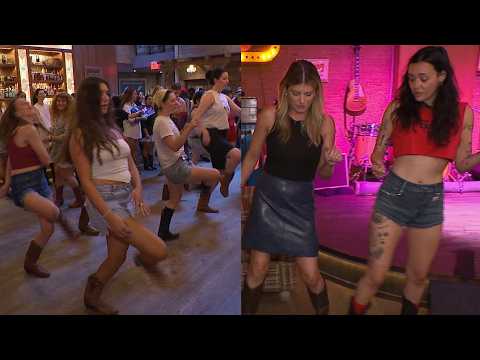

Chart basis: counts from Sport on Earth’s own carried data files at build time — verified videos carried for this sport (the verified pool: sport-videos.json + the desk league pools), news items carried (news.json), and league pages carried (desk.json). No external or estimated figures.
The filter sorts the Review Room embeds and the picture cards above by the keywords in their carried titles (review / analysis / recap and similar, or highlights). It runs entirely in your browser — nothing is sent anywhere.
No hall of fame with a published inductee list is carried for Line Dance. Sport on Earth does not invent halls or inductees: where a recognised hall publishes its list in a form this site can carry, the full list will appear here with its source named.
Solo dancers perform identical choreographed sequences in lines without partners, competing for world titles at UCWDC Worlds and Blackpool’s World Dance Masters.
The format, from this sport's verified record:
An arcade take on Line Dance: set the angle, set the power, and land the flyer in the landing mat. Five attempts; the closer to the middle, the more it scores. Arcade distances and a training arc — a game in the spirit of the sport, not a simulation of it.
This page’s own game is the arcade above. Everything else on the site that fits this sport is listed here — and anything borrowed from a similar sport is labelled as that sport’s game, never passed off as this one’s.
The tools on this site that honestly run on Line Dance — its own record first, then the site-wide general tools that apply. The full Line Dance toolkit prints the ones that do not apply, with the data reason why.
Site-wide tools, not built for Line Dance alone: Tournament Planner · My Notebook · The Labs · Design Studio · The Makers’ Bench · Match Day Desk · Play It Near You · Myth-Check Desk · Governing Bodies · Heat & Safety Calculator (WBGT) · Hydration Calculator · Training-Load Planner · Game Clock & Timer · Custom Rulebook Generator · Scout Notes Parser.
Behind the Play · Full treatment — from this sport’s own record
Solo dancers perform identical choreographed sequences in lines without partners, competing for world titles at UCWDC Worlds and Blackpool’s World Dance Masters.
Behind the Play takes the decisive actions of Line Dance apart: how the scoring play is built, which patterns the players are really running, and which rules remade the play into its modern shape.
The format, from this sport's verified record:
UCWDC founded to standardise country dance competition (1989). 21 independent dance organisers founded the UCWDC in 1989; its current rulebook states ’Since 1989, UCWDC has provided the most unique competitive dance experience in the world’ and that it creates and administers a uniform set of dance rules, contest procedures, scoring formats and rating systems for all UCWDC-sanctioned events.
One standardised circuit for couples and line dance, with certified judges and a qualifying path to a world championship; a Linedance NZ history additionally reports incorporation as a non-profit in Camp Hill, Pennsylvania, in 1990.
First UCWDC Country Dance World Championships held (1993). The council produced its first Worlds in January 1993 in Nashville, Tennessee, chosen, in former president Steve Zener’s words, because it was ’the home of country music’.
Worlds became the annual summit of the UCWDC season for couples, ProAm, ProPro, line dance, showtime and team competition; the 2025 edition was held in Orlando, Florida, at the Rosen Centre from 29 December 2024 to 5 January 2025.
World Dance Masters Ltd incorporated in England and Wales (2009). Companies House records World Dance Masters Ltd, company no. 06998501, as incorporated on 24 August 2009, with a certificate of change of name issued on 17 September 2009; WDM’s own site footer gives that company number for its UK registrations.
A second, line-dance-focused world-title circuit based in Blackpool exists alongside the UCWDC’s broader country-dance Worlds, and the two bodies crown separate champions — there is no unified line dance world champion.
From this page’s Rule Changes & Named Rules dossier, where every entry names its source.
Source basis: this sport’s carried record on this page (verified record, rule-changes dossier, history datasets) and the play patterns of its family as written in the site’s guides. Nothing here is invented.