Sport on Earth › Sports
Sport on Earth · Sport
Darts
Throw darts at a board; the PDC circuit is hugely popular in Europe.
League histories
- PDC — founded 1992. Professional darts’ leading organisation, running the PDC World Championship and world rankings.
Leagues
PDC Desk
PDC
24 team views · 21 pieces · 12 videos
News Desk
News stories from around the world, gathered and sourced by the Sport on Earth desk.
Darts on the program for PDC World Darts Championship 2026/27
Darts is carried on the program for PDC World Darts Championship 2026/27, 11 December 2026 – 3 January 2027, in Alexandra Palace, London. Throw darts at a board; the PDC circuit is hugely popular in Europe. The desk carries the sport’s full record — guide, calendar and history — on its own page.
PDC · Nov 2026
Columns & Stories
Written by Sport on Earth’s journalists — columns, features and interviews from the desk.
PDC Desk · Column
Taylor’s Fourteen Is the Mountain Littler Is Climbing
Every young champion needs a mountain, and the PDC roll this site carries gives darts its clearest one. Counted from the dataset — 33 PDC World Championship finals from Dennis Priestley’s 6–1 win over Phil Taylor in 1994 to Luke Littler’s 7–1 win over Gian van Veen in 2026 — Taylor won 14 of them. Michael van Gerwen, the defining player of the generation between them, won three. Littler, after the 2026 final, has two. The roll does not editorialise. It simply makes the arithmetic unavoidable: the teenager everyone calls an era has twelve more world titles to win before the argument with Taylor can even start.
November 1, 2026
PDC Desk · Column
The Roll Is the Argument: What BDO World Darts Championship finals Really Tells Us
Here is the column’s position, stated plainly: the bdo world darts championship finals roll — 43 editions, 1978 to 2020, counted from the record this site carries — is a better historian than any panel of experts. Panels argue about eras. The roll just keeps score, and its score says Eric Bristow won 5 of those editions. 11.6% of a competition’s entire history is not a hot streak; it is a structural fact.
November 2, 2026
PDC Desk · Column
The Roll Is the Argument: What PDC World Darts Championship finals Really Tells Us
Here is the column’s position, stated plainly: the pdc world darts championship finals roll — 33 editions, 1994 to 2026, counted from the record this site carries — is a better historian than any panel of experts. Panels argue about eras. The roll just keeps score, and its score says Phil Taylor won 14 of those editions. 42.4% of a competition’s entire history is not a hot streak; it is a structural fact.
November 2, 2026
PDC Desk · Column
Who Gets In, Who Waits: The PDC Hall of Fame Standard
The PDC Hall of Fame roll this site carries holds 20 names, inducted from 2005 to 2025. Every hall of fame is really two institutions: the one that inducts, and the one that makes the inducted argue about the standard. This column is about the second one.
November 2, 2026
PDC Desk · Column
Institutions Outlive Seasons: A Column on the PDC
A column about a league should begin where the league began: Founded 16 January 1992 as the World Darts Council by 16 players breaking away from the BDO; renamed Professional Darts Corporation in 1997.. The PDC — Professional darts’ leading organization, running the PDC World Championship and world rankings. — has since been many things, but it has never stopped being that founding decision, renewed every season.
November 2, 2026
PDC Desk · Column
The PDC Notebook: A League in Its Own Image
Every league desk keeps a notebook that is not really about results. This is ours for the PDC. The census record this site carries describes its sport in one line — Throw darts at a board; the PDC circuit is hugely popular in Europe. — and files it under Target & precision, in the target family of sports. One line is a discipline: before the desk argues about a league, it has to say what the league is.
November 2, 2026
PDC Desk · Column
What the PDC Record Asks of Its Next Season
A new season of the PDC makes three quiet demands, and the record — not the hype — names them. It asks about the roll’s next line: Luke Littler won the 2026 edition of the pdc world darts championship finals, and Dennis Priestley’s 32-year wait is the roll’s longest open one; the hall’s next class: the PDC Hall of Fame roll stands at 20 names, its most recent from 2025; the institution’s next chapter: a league founded in 1992 that has already survived every previous version of this argument.
November 2, 2026
PDC Desk · Feature
The Long Roll: BDO World Darts Championship finals and the Weight of Eric Bristow
Every roll of honor is an argument about time, and the bdo world darts championship finals roll — 43 editions counted from the record this site carries, running from 1978 to 2020 — argues louder than most. At the top of it sits Eric Bristow with 5 titles, 11.6% of every edition ever decided. The rest of the roll is the story of everyone who ever tried to move them.
November 2, 2026
PDC Desk · Feature
The Long Roll: PDC World Darts Championship finals and the Weight of Phil Taylor
Every roll of honor is an argument about time, and the pdc world darts championship finals roll — 33 editions counted from the record this site carries, running from 1994 to 2026 — argues louder than most. At the top of it sits Phil Taylor with 14 titles, 42.4% of every edition ever decided. The rest of the roll is the story of everyone who ever tried to move them.
November 2, 2026
PDC Desk · Feature
The First Class: PDC Hall of Fame and the 2005 Inductees
Every hall of fame is founded twice: once when the building opens, and once when the first class walks in. For the PDC Hall of Fame in Administered by the Professional Darts Corporation, that moment came in 2005, when 2 names were inducted together: Eric Bristow, John Lowe. The roll this site carries now runs to 20 inductees — and it still begins with them.
November 2, 2026
PDC Desk · Feature
So Close: Peter Manley and the PDC World Darts Championship finals Finals That Got Away
Peter Manley has reached 3 pdc world darts championship finals finals — 1999, 2002, 2006 — and won none of them. On the roll this site carries (33 editions, 1994 to 2026), no name has collected more finals without taking a title home.
November 9, 2026
PDC Desk · Feature
The Streak: Eric Bristow’s 3 Straight BDO World Darts Championship finals
Consecutive titles are the hardest currency on any roll, and the bdo world darts championship finals roll this site carries holds one clear entry: Eric Bristow, 3 straight editions from 1984 to 1986. Across 43 editions (1978 to 2020), no other run on the roll is longer.
November 17, 2026
PDC Desk · Feature
The Waiting: Dennis Priestley and the 32-Year PDC World Darts Championship finals Drought
Count the pdc world darts championship finals roll the way this site carries it — 33 editions, 1994 to 2026 — and its quietest line is a wait: Dennis Priestley last won it in 1994, 32 years before the roll’s latest edition. No other past champion on the roll has waited longer, and the roll measures the wait in public, one edition at a time.
November 24, 2026
PDC Desk · Interview — the Sport on Earth desk, in its own words
Five Questions With the PDC Desk
The Sport on Earth PDC desk takes questions on the Littler era and its chasing pack. The desk answers in its own words — no player is quoted, and nothing here is presented as anyone else’s statement.
PDC Desk · Interview — the Sport on Earth desk, in its own words
Five Questions With the PDC Desk: The BDO World Darts Championship finals Roll
The Sport on Earth PDC Desk takes questions on the bdo world darts championship finals roll. The desk answers in its own words — no player, coach or official is quoted, and nothing here is presented as anyone else’s statement. 43 editions, 1978–2020; most titles Eric Bristow (5); 26 distinct winners.
PDC Desk · Interview — the Sport on Earth desk, in its own words
Five Questions With the PDC Desk: The PDC World Darts Championship finals Roll
The Sport on Earth PDC Desk takes questions on the pdc world darts championship finals roll. The desk answers in its own words — no player, coach or official is quoted, and nothing here is presented as anyone else’s statement. 33 editions, 1994–2026; most titles Phil Taylor (14); 13 distinct winners.
PDC Desk · Interview — the Sport on Earth desk, in its own words
Five Questions With the PDC Desk: Inside the PDC Hall of Fame
The Sport on Earth PDC Desk takes questions on the PDC Hall of Fame. The desk answers in its own words — no player, coach or official is quoted, and nothing here is presented as anyone else’s statement. Every figure below is counted from the hall’s own roll as this site carries it.
PDC Desk · Interview — the Sport on Earth desk, in its own words
Five Questions With the PDC Desk: The PDC File
The Sport on Earth PDC Desk takes questions on the PDC file. The desk answers in its own words — no player, coach or official is quoted, and nothing here is presented as anyone else’s statement. The answers draw on the league history this site carries.
PDC Desk · Interview — the Sport on Earth desk, in its own words
Five Questions With the PDC Desk: The PDC Briefing
The Sport on Earth PDC Desk takes questions on the PDC. The desk answers in its own words — no player, coach or official is quoted, and nothing here is presented as anyone else’s statement. A standing briefing, refreshed from the files this site carries.
PDC Desk · Interview — the Sport on Earth desk, in its own words
Five Questions With the PDC Desk: PDC by the Numbers
The Sport on Earth PDC Desk takes questions on the PDC in numbers. The desk answers in its own words — no player, coach or official is quoted, and nothing here is presented as anyone else’s statement. Every answer below is a count taken from the site’s own files.
PDC Desk · Interview — the Sport on Earth desk, in its own words
Five Questions With the PDC Desk: BDO World Darts Championship finals, Decade by Decade
The Sport on Earth PDC Desk takes questions on the bdo world darts championship finals roll by decade. The desk answers in its own words — no player, coach or official is quoted, and nothing here is presented as anyone else’s statement. 43 editions, 1978–2020; most titles Eric Bristow (5); 26 distinct winners.
Writing Desk
Everything the desk has published for Darts, organised by section.
News
From the News Desk · all news, every sport →
Stories
- The Long Roll: BDO World Darts Championship finals and the Weight of Eric Bristow PDC Desk · November 2, 2026
- The Long Roll: PDC World Darts Championship finals and the Weight of Phil Taylor PDC Desk · November 2, 2026
- The First Class: PDC Hall of Fame and the 2005 Inductees PDC Desk · November 2, 2026
- So Close: Peter Manley and the PDC World Darts Championship finals Finals That Got Away PDC Desk · November 9, 2026
- The Streak: Eric Bristow’s 3 Straight BDO World Darts Championship finals PDC Desk · November 17, 2026
- The Waiting: Dennis Priestley and the 32-Year PDC World Darts Championship finals Drought PDC Desk · November 24, 2026
All stories across every sport →
Columns
- Taylor’s Fourteen Is the Mountain Littler Is Climbing PDC Desk · November 1, 2026
- The Roll Is the Argument: What BDO World Darts Championship finals Really Tells Us PDC Desk · November 2, 2026
- The Roll Is the Argument: What PDC World Darts Championship finals Really Tells Us PDC Desk · November 2, 2026
- Who Gets In, Who Waits: The PDC Hall of Fame Standard PDC Desk · November 2, 2026
- Institutions Outlive Seasons: A Column on the PDC PDC Desk · November 2, 2026
- The PDC Notebook: A League in Its Own Image PDC Desk · November 2, 2026
- What the PDC Record Asks of Its Next Season PDC Desk · November 2, 2026
All columns across every sport →
Interviews
- Five Questions With the PDC Desk PDC Desk
- Five Questions With the PDC Desk: The BDO World Darts Championship finals Roll PDC Desk
- Five Questions With the PDC Desk: The PDC World Darts Championship finals Roll PDC Desk
- Five Questions With the PDC Desk: Inside the PDC Hall of Fame PDC Desk
- Five Questions With the PDC Desk: The PDC File PDC Desk
- Five Questions With the PDC Desk: The PDC Briefing PDC Desk
- Five Questions With the PDC Desk: PDC by the Numbers PDC Desk
- Five Questions With the PDC Desk: BDO World Darts Championship finals, Decade by Decade PDC Desk
Shows
Sport on Earth’s daily and weekly video shows for Darts — every episode, newest first.
Darts Weekly Weekly show
Episode 1 — Price and Van Veen reach the Grand Slam final
Ep. 1 — the week ending Sunday, November 22, 2026 · 1:11
Videos
Every embed below was verified playable before listing — the network’s standing rule.
Ross Smith
This years Machineseeker European Champion: Ross Smith 🏆
#1 on the board · England
Wessel Nijman
Wessel Nijman vs Darryl Pilgrim | Players Championship 27 2026 🎯
#2 on the board · Netherlands
Nathan Aspinall
TWO NINE-DARTERS IN ONE DAY! 🤯 | Astonishing from Nathan Aspinall! | 2025 Players Championship 31
#3 on the board · England
Jonny Clayton
JONNY CLAYTON V ANDREAS HARRYSSON HIGHLIGHTS 2026 WORLD DARTS CHAMPIONSHIP
#4 on the board · Wales
Luke Humphries
GIAN VAN VEEN VS LUKE HUMPHRIES HIGHLIGHTS 2025 MACHINESEEKER EUROPEAN CHAMPIONSHIP DARTS FINAL
#5 on the board · England
View all videos (16)Show fewer videos
Gian van Veen
GIAN VAN VEEN VS CHARLIE MANBY HIGHLIGHTS 2026 WORLD DARTS CHAMPIONSHIP
#6 on the board · Netherlands
Luke Woodhouse
LUKE WOODHOUSE VS MAX HOPP HIGHLIGHTS 2026 WORLD DARTS CHAMPIONSHIP
#7 on the board · England
Chris Dobey
CHRIS DOBEY VS XIAOCHEN ZONG HIGHLIGHTS 2026 WORLD DARTS CHAMPIONSHIP
#8 on the board · England
DECIDING-LEG DRAMA! | 2026 Mr Vegas Grand Slam of Darts | Day Two Evening Highlights
YouTube · Professional Darts Corporation
RIDICULOUS PERFORMANCES! 🤯 | 2026 Mr Vegas Grand Slam of Darts | Day One Evening Highlights
YouTube · Professional Darts Corporation
SEEDED STARS EXIT! 🤯 | 2026 Mr Vegas Grand Slam of Darts | Day Two Afternoon Highlights
YouTube · Professional Darts Corporation
What The HELL Happened at This Weekend’s Grand Slam Of Darts??!
YouTube · The World of Darts Reporter
DARTS BRAWL ERUPTS! ... KIERAN LENNON TELLS THEM TO F* OFF! IRISH CLASSIC WDF Fake Score Ending...
YouTube · Match Darts
Grand Slam of Darts 2026 | Day 3 | Live Score Update
YouTube · Sports Updates By Anupam
DEBUT DELIGHT! 🙌 | 2026 Mr Vegas Grand Slam of Darts | Day One Afternoon Highlights
YouTube · Professional Darts Corporation
RACE FOR MINEHEAD 👀 | 2026 Players Championship 33 | Stream Two Highlights
YouTube · Professional Darts Corporation
Everything for Darts
Pages
On this page
- Visit the Darts Hub →
- League histories
- Leagues
- News Desk
- Columns & Stories
- Writing Desk
- Videos
- Reader comments
- Games, Lab & Calendar
- Story extras
- Season Calendar
- The Physics Lab
- The Record Lab
- Sponsorship History
- How to Play Darts
- Analytics — Darts
- Rule Changes & Named Rules
- Results & Fixtures
- History & Records
- Review Room — in-game and post-game review & analysis
- Darts in pictures & numbers
- Hall of Fame
- The Sport in Depth
- Stories from the Record
- On screen
- Tools for Darts
- Darts — Tactics & Strategy
- Behind the Play
Games, Lab & Calendar
Games for this sport
No game on this site is made specifically for Darts yet. The games below are the site's all-sport games, which honestly cover every sport — nothing from another sport has been dressed up as this sport's game.
Daily Trivia
A new set of questions every day, across every sport this site covers.
Top Sport on Earth
Real-athlete Top Sport on Earth decks built from the site’s verified board data.
The Lab
Darts's lab is the Physics Lab section on this page — the applied physics of its sport family, with a computed interactive where one honestly fits.
Physics Arena — the general biomechanics & physics teaching sandbox, shared by every sport.
The homepage sport explorer also carries a general Lab tab of small interactive experiments.
Season calendar
Calendar data not yet carried for Darts — this site does not yet hold schedule data for it, so no dates are shown rather than invented.
Story extras
Fan poll
Which desk story should we follow up?
Votes are counted on the Sport on Earth server and the totals shown are every reader’s votes; your own choice is remembered in this browser.
Key numbers — The Long Roll: BDO World Darts Championship finals and the Weight of Eric Bristow
Bars use only the metrics in the desk's summary data whose values are purely numeric; labels and values are shown verbatim.
How this story developed
Dated news entries for Darts, newest first, dates exactly as carried in the site’s news data.
- Nov 2026 — Darts on the program for PDC World Darts Championship 2026/27 (PDC)
Season Calendar
Flagship dates — verified
The flagship competitions on the calendar, with the dates for the current/upcoming cycle. Every date below was verified against the named source on 1 November 2026; dates change, and the source is the authority.
| Event | Dates | Where | Source |
|---|---|---|---|
| PDC World Darts Championship 2026/27 | 11 December 2026 – 3 January 2027 | Alexandra Palace, London | PDC — championship dates announcement |
The Physics Lab
Precision is applied physics repeated perfectly
Every target sport is the same problem restated: deliver a projectile (or judge its pace) so that a repeatable physical action produces a repeatable outcome. For thrown and shot projectiles the flight model below applies — no air resistance, no spin, flat ground — and the spread of your groupings is the visible signature of tiny variations in release speed and angle.
In the judged-pace games (bowls, curling, petanque family) the physics is friction and the biased or swept path: a curling stone curls because of asymmetric friction under its running band, and sweeping momentarily lowers that friction to extend and straighten the path. In cue sports, collisions are near-elastic momentum transfers — the calculator’s companion model in the Physics Arena covers impact maths.
From this sport's own record: Throw darts at a board; the PDC circuit is hugely popular in Europe. The lab above treats the physics of the sport's family; no measurement specific to this sport is printed, because the site's verified record for it carries none — parameters are never invented to fill a lab.
Try it: projectile flight calculator
Model: R = v²·sin(2θ)/g, flight time T = 2·v·sin(θ)/g, apex H = (v·sin θ)²/(2g), g = 9.81 m/s². Assumptions: no air resistance, no spin, flat ground, launch and landing at the same height. Real balls and shuttles fly shorter and curve — drag and spin are exactly what this model leaves out, so treat the output as the gravity-only ceiling, not a prediction.
The general teaching sandbox for every sport is the Physics Arena on the Games page — the same printed models, with a defender added.
The Record Lab
The hands-on lab for Darts, built entirely from the record this site carries for it — its documented rolls, its halls, its venues, its calendar and its census family. Every figure below is computed from that carried record at build time; nothing is estimated and nothing is pulled live. The companion Physics Lab on this page works the family's physics; this lab works the record.
Champions explorer — PDC World Darts Championship finals
Computed from the roll itself: 33 editions carried (1994–2026). Most titles in the carried roll:
- Phil Taylor — 14 titles
- Michael van Gerwen — 3 titles
- John Part — 2 titles
- Adrian Lewis — 2 titles
- Gary Anderson — 2 titles
Basis: the documented dataset “PDC World Darts Championship finals” carried on this site (Sport on Earth’s documented datasets). Counts are computed from the carried rows only — editions the roll does not carry are not estimated.
Hall of Fame explorer
Darts carries 1 hall in the site’s record — PDC Hall of Fame — with 20 inductees carried, 16 of them with a full verified profile on this site.
Inductions by decade (computed from the carried induction years):
2000s8
2010s8
2020s4
Basis: the Hall of Fame record carried on this site — the same rolls and verified profiles the Hall of Fame books print. Inductees a hall lists but the site has not verified stay list-only, exactly as the books state.
Venue explorer
The carried global venue dataset holds 2 venues for Darts across 2 countries. The largest capacity the dataset records for this sport is 5,000 — Marshall Arena, .
Basis: the global venue dataset carried on this site (6,438 venues with coordinates; the venue explorer on the sports index and the stadium sun table work the same data). Countries beyond the 25 largest are counted in the totals above but not listed here.
The carried calendar
- PDC World Darts Championship 2026/27 — 11 December 2026 – 3 January 2027, Alexandra Palace, London
Basis: the dated events this entry’s own record carries, as announced by the bodies named in the record. A sport whose record carries no fixed dated calendar says so on its calendar page rather than inventing one.
The family lab — Target & precision sports
Computed from the site census: the Target & precision sports family holds 53 entries on this site. Across the family, the carried record includes documented rolls for 5 of them, Hall of Fame data for 6, venue sets for 8, and dated calendars for 6.
Every other entry in the family: Air Hockey · Airsoft · Archery · Asyk · Axe Throwing · Battle of the Oranges · Bocce · Boccia · Boomerang Throwing · Calva · Carom Billiards · Carrom · Chunkey · Cornhole · Crokinole · Croquet · Crud · Curling · Disc Golf · FlingGolf · Footgolf · Gateball · Golf · Gorodki · Horseshoes · Jukskei · Klootschieten · Kolf · Kubb · Kyudo · Kyykkä · Lagori · Lawn Bowls · Marbles · Mölkky · Novuss · Paintball · Pool · Pétanque · Road Bowling · Roque · Shooting · Shuffleboard · Skully / Skelly · Snookball · Snooker · Sport stacking · Stone Skimming · Tejo · Ten-pin Bowling · Tiddlywinks · Woodball
Basis: the Sport on Earth census itself — the same 460-entry register the census page prints.
Sponsorship History
The sponsorship record of Darts — title sponsors, jersey and kit deals, venue naming rights, firsts and record deals — from published sources only. Current deals are tracked on the Money Desk sponsorship page.
Early PDC World Championship sponsors 1994-2002
The PDC World Championship's main sponsors in its first decade were Skol International (1994-1995 and again 1998-2002), Proton Cars (1995-1996) and Vernons (1996-1997), before the long betting-company era began.
Ladbrokes and William Hill betting eras 2003-2022
Ladbrokes sponsored the PDC World Darts Championship from 2003 to 2014, followed by William Hill from 2015 to 2022. Those two bookmakers held the title rights for two decades between them.
Cazoo one-year bridge to Paddy Power 2023-
Online car retailer Cazoo sponsored the championship in 2023, then bookmaker Paddy Power took over from 2024. Paddy Power has since extended its title sponsorship through to 2031.
Sponsorship sources: Wikipedia - PDC World Darts Championship · Darts Oche · Sportcal
How to Play Darts
How this game is played, gathered from the record Sport on Earth already carries for Darts, with the positions taken from the sourced chart cited in that section.
Core rules
Darts’ scoring core — 501 down, double out — has not changed in the modern era, and this dossier does not pretend otherwise. The game’s dated changes live where darts actually changes: in the procedures around the throw, above all the one a single sudden-death leg at the Circus Tavern rewrote in 2007.
The current rules, as the site's rule-change dossier records them:
- The Bull Must Be Cleared (the 2007 Bull-Off Change) (PDC, 2007): Under the PDC ruling that followed the 2007 final, the first player’s dart must be removed from the board before the second player throws: only a bullseye or outer bull counts toward winning the throw, every attempt is made at a clear board, and darts are retrieved after each throw, with the throwing order alternating on re-throws until someone wins it.
- The World Matchplay Tiebreak Cap (PDC (World Matchplay), 2013): From the 2013 World Matchplay, tiebreaks settle close contests: a match still level after five extra legs is decided by one final leg played at the original order of throw — a first-round match at 12–12 goes to a 25th and deciding leg, the final at 20–20 to a 41st — and instead of a bull-off to decide who throws first in the crucial leg, the order of throw remains unchanged.
The full dossier — every dated change and named rule, with its source basis — is in this page’s Rule Changes & Named Rules section.
Positions & basic plays
Darts has no fixed positions — its format designates no positional roles.
Format as carried in hidden_files/batchB-nov1/batchb_data.json: "Throw darts at a board; the PDC circuit is hugely popular in Europe." The format carries no designated positional roles. (Source: Sport on Earth carried sport record.)
Its Tactics & Strategy book — its opening entries, the basic plays, are:
- The Checkout Chart (170 and Down) — From 170 (treble 20, treble 20, bull) downward, every score has its standard finish: the chart is memorised like an opening book, because the last three darts have no time for arithmetic. When it’s used: The finish is chosen before the visit begins — checkout darts are thrown at decisions already made.
- The Setup Shot — The visit before the finish is a play of its own: from 200-odd, the darts are thrown not for maximum score but to leave a favourite double — the setup is the checkout’s first half. When it’s used: Scoring and setting up are different visits wearing the same three darts.
- Scoring Phases (the 180 Economy) — Maximums are the game’s spectacle, but matches are won by the visits between them: the 100-and-140 economy, the cover shots to treble 19 when the 20s are blocked, and the refusal to chase a blocked treble. When it’s used: Counting is a craft of alternatives: every treble has a cover number.
- Doubles Under Pressure (the Split Rule) — Finishing doubles are chosen for their splits: double 16 missed inside leaves double 8, missed again leaves double 4 — the family of forgiving doubles that the chart prefers when the hand shakes. When it’s used: The arithmetic of mercy: a double that forgives is worth more than a double that is ’yours’.
The full book carries 8 entries — in this page’s Playbook / Tactics & Strategy section, and at the Playbooks hub.
Analytics — Darts
Sport on Earth's own analytics: every figure in this panel is computed at build time from the record this site itself carries, with the source named. No outside data is used, and no betting figures of any kind.
Champions-roll concentration
- PDC World Darts Championship finals: 33 carried editions (1994–2026), 13 different champions; most successful Phil Taylor — 14 (42.4%); concentration HHI 0.2121, effective champions 4.71.
- BDO World Darts Championship finals: 43 carried editions (1978–2020), 26 different champions; most successful Eric Bristow — 5 (11.6%); concentration HHI 0.0546, effective champions 18.31.
Computed from the site's documented champions datasets — the same rolls behind the Parity Tracker.
Hall of Fame record carried: 20 inductees across 1 hall(s); inductions span 2005–2025; the largest induction decade is the 2000s (8 inductees).
Source: the site's carried hall-of-fame record (historical-players.json).
Venues carried: 2 in 2 countries; the largest carried capacity is 5,000 (Marshall Arena).
Source: the site's global venue record (venues-global.json); a capacity is printed only where the record carries a verified one.
Census arithmetic: Darts sits in the target sports family — 53 census sports, of which 5 carry a qualifying champions roll in the site's record.
Rule Changes & Named Rules
Darts’ scoring core — 501 down, double out — has not changed in the modern era, and this dossier does not pretend otherwise. The game’s dated changes live where darts actually changes: in the procedures around the throw, above all the one a single sudden-death leg at the Circus Tavern rewrote in 2007.
The Bull Must Be Cleared (the 2007 Bull-Off Change)
Before: To decide who throws first — above all in a sudden-death leg — the players threw one dart each at the bull, closest to the bull winning the throw. If the first dart landed in the bull or outer bull, it could be left in the board at the second player’s request, sitting there as a physical marker a fraction from the centre he was aiming at.
The change: Under the PDC ruling that followed the 2007 final, the first player’s dart must be removed from the board before the second player throws: only a bullseye or outer bull counts toward winning the throw, every attempt is made at a clear board, and darts are retrieved after each throw, with the throwing order alternating on re-throws until someone wins it.
Why it happened: The 2007 PDC World Championship final — the last at the Circus Tavern — went to a sudden-death leg at six sets all and five legs all. Phil Taylor threw first for the bull and hit the outer bull; Raymond van Barneveld asked for the dart to be left in, clipped his own dart off Taylor’s into the bullseye, won the throw, and won the leg and the title. The advantage was so visible that the procedure itself was judged unfair.
In practice today: Bull-offs in the professional game are now throw-for-throw at an empty bull — referee Russ Bray, who called that final, has said on record that it was the last time a dart could be left in — and the 2007 final survives as the rare single leg that rewrote a playing procedure overnight.
The World Matchplay Tiebreak Cap
Before: World Matchplay matches had to be won by two clear legs, with no ceiling: a match could run past its scheduled distance in two-leg increments for as long as the players stayed level — a scheduling and fairness problem in a televised event, and liable to be ended eventually by a bull-off lottery rather than by the match’s own play.
The change: From the 2013 World Matchplay, tiebreaks settle close contests: a match still level after five extra legs is decided by one final leg played at the original order of throw — a first-round match at 12–12 goes to a 25th and deciding leg, the final at 20–20 to a 41st — and instead of a bull-off to decide who throws first in the crucial leg, the order of throw remains unchanged.
Why it happened: The PDC consulted host broadcaster Sky Sports and agreed the cap: win-by-two was preserved as the match’s first principle, but five extra legs of it was set as the limit a match — and a broadcast — could hold, and the decider would keep the established throwing order rather than restart the contest with a fresh bull throw.
In practice today: The Matchplay kept its marathon character inside a hard boundary. The open-ended two-leg grind is gone from Blackpool; the tournament’s signature arithmetic now ends, at the latest, in a single-leg shoot-out whose throw order the whole match has already earned.
Source basis: Sky Sports’ account of the 2007 PDC World Championship final and the bull-off change that followed it (including referee Russ Bray’s on-record explanation that ’these days you have to take the dart out’), corroborated by SportBible’s and Darts Corner’s accounts of the PDC ruling; contemporary (July 2013) reporting of the PDC’s World Matchplay tiebreak rules, published from the PDC’s own rule summary.
Results & Fixtures
Sport on Earth carries no results feed for Darts: no scores or fixtures are published here, rather than inventing them. The sport's documented record is in its history page and the History & Records section of this page.
History & Records
The historical record for Darts — past standings, champions, title history and all-time leaders, as deep as verifiable public records go.
PDC World Darts Championship finals — 33 entries
| Year | Champion | Score | Runner-up |
|---|---|---|---|
| 1994 | Dennis Priestley | 6–1 | Phil Taylor |
| 1995 | Phil Taylor | 6–2 | Rod Harrington |
| 1996 | Phil Taylor | 6–4 | Dennis Priestley |
| 1997 | Phil Taylor | 6–3 | Dennis Priestley |
| 1998 | Phil Taylor | 6–0 | Dennis Priestley |
| 1999 | Phil Taylor | 6–2 | Peter Manley |
| 2000 | Phil Taylor | 7–3 | Dennis Priestley |
| 2001 | Phil Taylor | 7–0 | John Part |
| 2002 | Phil Taylor | 7–0 | Peter Manley |
| 2003 | John Part | 7–6 | Phil Taylor |
| 2004 | Phil Taylor | 7–6 | Kevin Painter |
| 2005 | Phil Taylor | 7–4 | Mark Dudbridge |
| 2006 | Phil Taylor | 7–0 | Peter Manley |
| 2007 | Raymond van Barneveld | 7–6 | Phil Taylor |
| 2008 | John Part | 7–2 | Kirk Shepherd |
| 2009 | Phil Taylor | 7–1 | Raymond van Barneveld |
| 2010 | Phil Taylor | 7–3 | Simon Whitlock |
| 2011 | Adrian Lewis | 7–5 | Gary Anderson |
| 2012 | Adrian Lewis | 7–3 | Andy Hamilton |
| 2013 | Phil Taylor | 7–4 | Michael van Gerwen |
| 2014 | Michael van Gerwen | 7–4 | Peter Wright |
| 2015 | Gary Anderson | 7–6 | Phil Taylor |
| 2016 | Gary Anderson | 7–5 | Adrian Lewis |
| 2017 | Michael van Gerwen | 7–3 | Gary Anderson |
| 2018 | Rob Cross | 7–2 | Phil Taylor |
| 2019 | Michael van Gerwen | 7–3 | Michael Smith |
| 2020 | Peter Wright | 7–3 | Michael van Gerwen |
| 2021 | Gerwyn Price | 7–3 | Gary Anderson |
| 2022 | Peter Wright | 7–5 | Michael Smith |
| 2023 | Michael Smith | 7–4 | Michael van Gerwen |
| 2024 | Luke Humphries | 7–4 | Luke Littler |
| 2025 | Luke Littler | 7–3 | Michael van Gerwen |
| 2026 | Luke Littler | 7–1 | Gian van Veen |
Source basis: Wikipedia — “PDC World Darts Championship” (accessed Nov 1, 2026); parsed mechanically from the article’s published table. Material from Wikipedia is used under CC BY-SA 4.0..
BDO World Darts Championship finals — 43 entries
| Year | Champion | Score | Runner-up |
|---|---|---|---|
| 1978 | Leighton Rees | 11 – 7 legs | John Lowe |
| 1979 | John Lowe | 5 – 0 sets | Leighton Rees |
| 1980 | Eric Bristow | 5 – 3 | Bobby George |
| 1981 | Eric Bristow | 5 – 3 | John Lowe |
| 1982 | Jocky Wilson | 5 – 3 | John Lowe |
| 1983 | Keith Deller | 6 – 5 | Eric Bristow |
| 1984 | Eric Bristow | 7 – 1 | Dave Whitcombe |
| 1985 | Eric Bristow | 6 – 2 | John Lowe |
| 1986 | Eric Bristow | 6 – 0 | Dave Whitcombe |
| 1987 | John Lowe | 6 – 4 | Eric Bristow |
| 1988 | Bob Anderson | 6 – 4 | John Lowe |
| 1989 | Jocky Wilson | 6 – 4 | Eric Bristow |
| 1990 | Phil Taylor | 6 – 1 | Eric Bristow |
| 1991 | Dennis Priestley | 6 – 0 | Eric Bristow |
| 1992 | Phil Taylor | 6 – 5 | Mike Gregory |
| 1993 | John Lowe | 6 – 3 | Alan Warriner |
| 1994 | John Part | 6 – 0 | Bobby George |
| 1995 | Richie Burnett | 6 – 3 | Raymond van Barneveld |
| 1996 | Steve Beaton | 6 – 3 | Richie Burnett |
| 1997 | Les Wallace | 6 – 3 | Marshall James |
| 1998 | Raymond van Barneveld | 6 – 5 | Richie Burnett |
| 1999 | Raymond van Barneveld | 6 – 5 | Ronnie Baxter |
| 2000 | Ted Hankey | 6 – 0 | Ronnie Baxter |
| 2001 | John Walton | 6 – 2 | Ted Hankey |
| 2002 | Tony David | 6 – 4 | Mervyn King |
| 2003 | Raymond van Barneveld | 6 – 3 | Ritchie Davies |
| 2004 | Andy Fordham | 6 – 3 | Mervyn King |
| 2005 | Raymond van Barneveld | 6 – 2 | Martin Adams |
| 2006 | Jelle Klaasen | 7 – 5 | Raymond van Barneveld |
| 2007 | Martin Adams | 7 – 6 | Phill Nixon |
| 2008 | Mark Webster | 7 – 5 | Simon Whitlock |
| 2009 | Ted Hankey | 7 – 6 | Tony O’Shea |
| 2010 | Martin Adams | 7 – 5 | Dave Chisnall |
| 2011 | Martin Adams | 7 – 5 | Dean Winstanley |
| 2012 | Christian Kist | 7 – 5 | Tony O’Shea |
| 2013 | Scott Waites | 7 – 1 | Tony O’Shea |
| 2014 | Stephen Bunting | 7 – 4 | Alan Norris |
| 2015 | Scott Mitchell | 7 – 6 | Martin Adams |
| 2016 | Scott Waites | 7 – 1 | Jeff Smith |
| 2017 | Glen Durrant | 7 – 3 | Danny Noppert |
| 2018 | Glen Durrant | 7 – 6 | Mark McGeeney |
| 2019 | Glen Durrant | 7 – 3 | Scott Waites |
| 2020 | Wayne Warren | 7 – 4 | Jim Williams |
Source basis: Wikipedia — “BDO World Darts Championship” (accessed Nov 1, 2026); parsed mechanically from the article’s published table. Material from Wikipedia is used under CC BY-SA 4.0..
Review Room — in-game and post-game review & analysis
The review and analysis videos from Darts’s verified video pool — every embed below was identity-checked and probed playable before listing, the site’s standing rule. Nothing here is a show Sport on Earth produces; these are the review, post-game and breakdown videos the pool already carries for this sport.
No verified review-show video is carried for this sport yet.
Darts in pictures & numbers

This years Machineseeker European Champion: Ross Smith 🏆
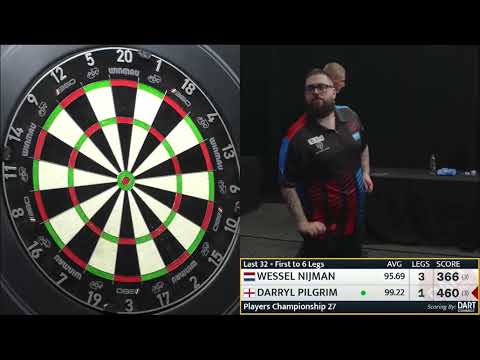
Wessel Nijman vs Darryl Pilgrim | Players Championship 27 2026 🎯

TWO NINE-DARTERS IN ONE DAY! 🤯 | Astonishing from Nathan Aspinall! | 2025 Players Championship 31
Chart basis: counts from Sport on Earth’s own carried data files at build time — verified videos carried for this sport (the verified pool: sport-videos.json + the desk league pools), news items carried (news.json), and league pages carried (desk.json). No external or estimated figures.
The filter sorts the Review Room embeds and the picture cards above by the keywords in their carried titles (review / analysis / recap and similar, or highlights). It runs entirely in your browser — nothing is sent anywhere.
Hall of Fame
PDC Hall of Fame
Administered by the Professional Darts Corporation
20 inductees — every name on the hall's published list, grouped by class year.
2005 — Eric Bristow · John Lowe
2006 — Freddie Williams
2007 — Phil Jones · John Raby
2008 — Sid Waddell · Dave Lanning
2009 — Dennis Priestley
2010 — Dick Allix · Tommy Cox
2011 — Phil Taylor
2013 — Bruce Spendley
2014 — John Gwynne
2017 — John Part
2018 — Dave Clark
2019 — Rod Harrington
2021 — Barry Hearn
2024 — Russ Bray
2025 — George Noble · John McDonald
Source basis: Wikipedia — "PDC Hall of Fame" (accessed Nov 1, 2026); parsed mechanically from the article’s published table. Material from Wikipedia is used under CC BY-SA 4.0..
Full inductee profiles → 16 of the 20 inductees above carry a full verified profile — biography, induction record and verified video where one exists. The rest are list-only until a biography can be verified the same way.
The Sport in Depth
How it’s played
Throw darts at a board; the PDC circuit is hugely popular in Europe.
In the wider target family of sports — precision is applied physics repeated perfectly, the game turns on: Process over outcome: a repeatable routine — stance, aim, release, follow-through — because results follow process with a lag.; Read before you play: line, pace and conditions are decided before the delivery starts; changing mid-action is where errors live.; Grouping before centring: tighten the pattern of attempts first; then move the whole pattern onto the target.; One-ball-at-a-time scoring: target games punish carrying the last miss into the next attempt more than any single bad throw.; The shot routine is the skill: a repeatable pre-shot sequence holds technique together when the score starts to matter.; Conditions separate fields: wind, light and surface change the same delivery’s result — reading them is a scoring skill, not local knowledge..
The pro scene
Sport on Earth carries no team or player directory for this sport, because no structured public feed publishes a verifiable one. What is carried is the documented record on this page — history, rules, honours and the calendar — each with its source named.
📖 Darts — Tactics & Strategy — every entry, plus the arcade strategy, at the foot of this page.
Darts Arcade — Dead-Eye
An arcade take on Darts: set the angle, set the power, and land the dart in the bullseye. Five attempts; the closer to the middle, the more it scores. Arcade distances and a training arc — a game in the spirit of the sport, not a simulation of it.
More ways to play Darts
This page’s own game is the arcade above. Everything else on the site that fits this sport is listed here — and anything borrowed from a similar sport is labelled as that sport’s game, never passed off as this one’s.
- Quiz track — 6 questions on Darts, drawn from this site's own record for the sport: Quiz Tracks (choose “Darts”).
- Top Sport on Earth — Darts is one of the 455 sport cards in the SPORTS deck: play Top Sport on Earth.
- More in this family — Ten-pin Bowling Arcade — The Strike: the game of Ten-pin Bowling, a similar sport in Darts’s family.
- Everything else the site runs lives on the Games hub.
On screen
1 verified documentaries, films and series about this sport are listed in the site's screen guide: Sport on Screen — Darts.
Tools for Darts
The tools on this site that honestly run on Darts — its own record first, then the site-wide general tools that apply. The full Darts toolkit prints the ones that do not apply, with the data reason why.
Tools that run on Darts’s own record
- Venue Profiles — The venue directories the site carries name 2 venues for this sport, with the flagship grounds documented from the structured record.
General tools that also apply
Site-wide tools, not built for Darts alone: Tournament Planner · My Notebook · The Labs · Design Studio · The Makers’ Bench · Match Day Desk · Play It Near You · Myth-Check Desk · Governing Bodies · Heat & Safety Calculator (WBGT) · Hydration Calculator · Training-Load Planner · Game Clock & Timer · Custom Rulebook Generator · Scout Notes Parser.
Darts — Tactics & Strategy
Tactics & Strategy — this sport’s book
darts’ book — the checkout chart is a literal playbook: every remaining score has a rehearsed route to zero, and the setup shot that creates it is a called play.
8 entries, plus the arcade strategy below. All wording is original coaching-vocabulary prose; nothing is copied from any proprietary playbook.
The Checkout Chart (170 and Down)
From 170 (treble 20, treble 20, bull) downward, every score has its standard finish: the chart is memorised like an opening book, because the last three darts have no time for arithmetic.
When it’s used: The finish is chosen before the visit begins — checkout darts are thrown at decisions already made.
The sequence
- The chart’s logic prefers doubles that split kindly (a miss inside leaves another double).
- Bogey numbers (169, 168, 166, 165, 163, 162, 159) cannot be finished in three darts — the setup must avoid leaving them.
- The professional counts backward from the finish while the opponent throws.
The Setup Shot
The visit before the finish is a play of its own: from 200-odd, the darts are thrown not for maximum score but to leave a favourite double — the setup is the checkout’s first half.
When it’s used: Scoring and setting up are different visits wearing the same three darts.
The sequence
- Leave 32 (double 16) or 40 (double top) where nerve allows: the kindest doubles in the game.
- A setup that risks the bust is a checkout refused: the last dart’s target shrinks to safety when needed.
- The opponent’s score prices the setup: against a man on a finish, the setup gambles for the bigger leave.
Scoring Phases (the 180 Economy)
Maximums are the game’s spectacle, but matches are won by the visits between them: the 100-and-140 economy, the cover shots to treble 19 when the 20s are blocked, and the refusal to chase a blocked treble.
When it’s used: Counting is a craft of alternatives: every treble has a cover number.
The sequence
- A dart lying in the treble 20’s low side calls the cover shot to 19s — the professional switches without sentiment.
- The first dart is the marker: the other two are thrown at it, not at the treble.
- 180s cluster in the game’s record because the marker system works — the chart and the stack are one doctrine.
Doubles Under Pressure (the Split Rule)
Finishing doubles are chosen for their splits: double 16 missed inside leaves double 8, missed again leaves double 4 — the family of forgiving doubles that the chart prefers when the hand shakes.
When it’s used: The arithmetic of mercy: a double that forgives is worth more than a double that is ’yours’.
The sequence
- Double top (40) is the favourite’s favourite for its size and its split to double 10.
- The bull finish (170, 161, 160 routes) is the chart’s theatre — taken when the arithmetic demands, not the crowd.
- Practice doubles in their split families, never alone: the visit after a miss is the real drill.
The 501 Race (Match Craft)
The straight race to zero is managed like a innings: the throw’s order (the cork/bull for the throw), the sets’ rhythm, and the knowledge of when a leg is lost three visits before it ends.
When it’s used: Legs are abandoned on schedule and stolen on arithmetic.
The sequence
- Winning the throw at the bull is a genuine edge — the darts’ version of the serve.
- A leg is chased while the gap is under two visits; beyond that, the next leg’s throw is the asset protected.
- The opponent’s counting is watched like a tell: his setup reveals his finish two visits early.
The Cricket Game (the Other Book)
In cricket darts, numbers 15-20 and the bull are opened, closed and pointed: the tactics invert — you score points on numbers your opponent has failed to close, and the game’s end is a count of closures, not a race to zero.
When it’s used: The pointing game: territory, not speed.
The sequence
- Close the high numbers early; point on the opponent’s open numbers without mercy or haste.
- The bull is the game’s last argument — its closure decides most level matches.
- A lead in points licenses defence: closing becomes the whole visit.
The Throw Itself (the Repeatable Dart)
The mechanics are a play repeated: stance at the oche, elbow’s hinge, the release at the same point of the same arc — consistency of the motion is the technique every tactic stands on.
When it’s used: Darts is a closed skill: the tactic is the motion’s fidelity.
The sequence
- The oche line disciplines the feet so the arm’s geometry never changes address.
- The follow-through points at the target: a dart released early flies the hand’s last lie.
- Grouping is the practice metric — the treble is a group that happens to score.
Matchplay Formats (Sets vs Legs)
The sets format forgives a lost leg inside a won set; the legs format (matchplay’s race) forgives nothing: the same player is two different tacticians under the two counts, and the book says so.
When it’s used: A tactics entry: format is a rule of the game that rewrites the game’s risks.
The sequence
- In sets, a set down is a leg’s price; in a pure race, every leg is the last one’s brother.
- The break of throw is the sets game’s currency — hold, break, and the set is a formality.
- Doubling the stakes late (the Premier League’s nights, the majors’ long races) rewards the checkout chart’s depth over the hot hand.
Playing the Game
Playing the Game — Dead-Eye
The arcade cell · strategy
This page’s arcade cell: launch the dart at the bullseye from the putting green · 40 m (arcade scale). Angle, power, launch — five attempts, and the cell keeps your best.
When it’s used: On this page, in the Play section — and its strategy is the same craft as the book above it, miniaturised.
The sequence
- Set the angle first. The target is the bullseye, the putting green · 40 m (arcade scale) — the angle is chosen for where the dart must finish, not where it starts.
- Set the power second, on the sweeping meter: the scoring zone is a band, not a point, so aim for the middle of the band you can repeat, not the edge you can imagine.
- Launch, and read the result like a rangefinder: every attempt tells you the cell’s wind — there is none, so a miss is a measurement error, and it is yours to correct on the next attempt.
- You have 5 attempts. This is a precision cell: the smallest repeatable power beats the biggest heroic one, every attempt.
- The cell’s own honesty line applies: arcade distances; a game, not a simulation.
Part of the Sport on Earth Playbooks — a book for every sport and every game on the site.
Behind the Play
Behind the Play · From the carried record
Throw darts at a board; the PDC circuit is hugely popular in Europe.
Behind the Play takes the decisive actions of Darts apart: how the scoring play is built, which patterns the players are really running, and which rules remade the play into its modern shape.
The patterns behind the play
- Process over outcome: a repeatable routine — stance, aim, release, follow-through — because results follow process with a lag.
- Read before you play: line, pace and conditions are decided before the delivery starts; changing mid-action is where errors live.
- Grouping before centring: tighten the pattern of attempts first; then move the whole pattern onto the target.
- One-ball-at-a-time scoring: target games punish carrying the last miss into the next attempt more than any single bad throw.
- The shot routine is the skill: a repeatable pre-shot sequence holds technique together when the score starts to matter.
- Conditions separate fields: wind, light and surface change the same delivery’s result — reading them is a scoring skill, not local knowledge.
The moves in the book
- Line
- The intended path of the ball, stone, dart or shot toward the target — read before every attempt.
- Release
- The moment the projectile leaves the hand or implement; the point where most errors are made.
- Follow-through
- The completion of the delivery action after release; a consistent follow-through is the mark of a repeatable action.
- Grouping
- The pattern of several attempts on the target — tight groupings show a repeatable action even before they are centred.
- Draw weight
- In bowls and curling family games, the precise pace that lets the bowl or stone finish on the target.
Source basis: this sport’s carried record on this page (verified record, rule-changes dossier, history datasets) and the play patterns of its family as written in the site’s guides. Nothing here is invented.