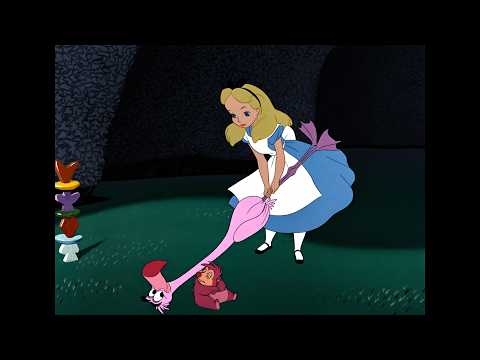
Alice In Wonderland 1951 Alice playing croquet with the Queen of Hearts
YouTube · FilmClips
Pages
On this page
Sport on Earth › Sports
Sport on Earth · Sport
Mallet game hitting balls through hoops.
Every embed below was verified playable before listing — the network’s standing rule.
YouTube · FilmClips
Pages
On this page
No game on this site is made specifically for Croquet yet. The games below are the site's all-sport games, which honestly cover every sport — nothing from another sport has been dressed up as this sport's game.
A new set of questions every day, across every sport this site covers.
Real-athlete Top Sport on Earth decks built from the site’s verified board data.
Croquet's lab is the Physics Lab section on this page — the applied physics of its sport family, with a computed interactive where one honestly fits.
Physics Arena — the general biomechanics & physics teaching sandbox, shared by every sport.
The homepage sport explorer also carries a general Lab tab of small interactive experiments.
Calendar data not yet carried for Croquet — this site does not yet hold schedule data for it, so no dates are shown rather than invented.
Which section of this page should we expand first?
Votes are counted on the Sport on Earth server and the totals shown are every reader’s votes; your own choice is remembered in this browser.
Sport on Earth does not yet hold verified dated events for Croquet, and its carried record does not state the season's timing in words — so no calendar is shown rather than an invented one. What the site does carry for this sport is on this page: its verified record, its rules record and its history.
Every target sport is the same problem restated: deliver a projectile (or judge its pace) so that a repeatable physical action produces a repeatable outcome. For thrown and shot projectiles the flight model below applies — no air resistance, no spin, flat ground — and the spread of your groupings is the visible signature of tiny variations in release speed and angle.
In the judged-pace games (bowls, curling, petanque family) the physics is friction and the biased or swept path: a curling stone curls because of asymmetric friction under its running band, and sweeping momentarily lowers that friction to extend and straighten the path. In cue sports, collisions are near-elastic momentum transfers — the calculator’s companion model in the Physics Arena covers impact maths.
From this sport's own record: Mallet game hitting balls through hoops. The lab above treats the physics of the sport's family; no measurement specific to this sport is printed, because the site's verified record for it carries none — parameters are never invented to fill a lab.
Model: R = v²·sin(2θ)/g, flight time T = 2·v·sin(θ)/g, apex H = (v·sin θ)²/(2g), g = 9.81 m/s². Assumptions: no air resistance, no spin, flat ground, launch and landing at the same height. Real balls and shuttles fly shorter and curve — drag and spin are exactly what this model leaves out, so treat the output as the gravity-only ceiling, not a prediction.
The general teaching sandbox for every sport is the Physics Arena on the Games page — the same printed models, with a defender added.
The hands-on lab for Croquet, built entirely from the record this site carries for it — its documented rolls, its halls, its venues, its calendar and its census family. Every figure below is computed from that carried record at build time; nothing is estimated and nothing is pulled live. The companion Physics Lab on this page works the family's physics; this lab works the record.
The honest position: the record this site carries for Croquet is thin — no documented roll, hall, venue set or dated calendar is carried for it yet — so this entry’s lab is its family lab: the computed census of the family it belongs to. When the record grows, the lab grows with it; nothing here is estimated to fill the space.
Computed from the site census: the Target & precision sports family holds 53 entries on this site. Across the family, the carried record includes documented rolls for 5 of them, Hall of Fame data for 6, venue sets for 8, and dated calendars for 6.
Every other entry in the family: Air Hockey · Airsoft · Archery · Asyk · Axe Throwing · Battle of the Oranges · Bocce · Boccia · Boomerang Throwing · Calva · Carom Billiards · Carrom · Chunkey · Cornhole · Crokinole · Crud · Curling · Darts · Disc Golf · FlingGolf · Footgolf · Gateball · Golf · Gorodki · Horseshoes · Jukskei · Klootschieten · Kolf · Kubb · Kyudo · Kyykkä · Lagori · Lawn Bowls · Marbles · Mölkky · Novuss · Paintball · Pool · Pétanque · Road Bowling · Roque · Shooting · Shuffleboard · Skully / Skelly · Snookball · Snooker · Sport stacking · Stone Skimming · Tejo · Ten-pin Bowling · Tiddlywinks · Woodball
Basis: the Sport on Earth census itself — the same 460-entry register the census page prints.
The desk has not verified a sponsorship record for Croquet from published sources, so none is printed. Sponsorship history is added only when a real published source supports it — sponsor by sponsor, deal by deal. Current sponsorship deals across sport are tracked on the Money Desk sponsorship page.
How this game is played, gathered from the record Sport on Earth already carries for Croquet, with the positions taken from the sourced chart cited in that section.
Croquet changes its laws the way it plays: deliberately, by committee, in editions. But its two modern editions carry real law changes inside the tidying — a wrong-ball revolution in golf croquet in 2019, and the end of the forgiven mallet-touch in association croquet in 2021.
The current rules, as the site's rule-change dossier records them:
The full dossier — every dated change and named rule, with its source basis — is in this page’s Rule Changes & Named Rules section.
Croquet has no fixed positions — its format designates no positional roles.
Format as carried in hidden_files/batchB-nov1/batchb_data.json: "Mallet game hitting balls through hoops." The format carries no designated positional roles. (Source: Sport on Earth carried sport record.)
Its Playbook — its opening entries, the basic plays, are:
The full book carries 8 entries — in this page’s Playbook / Tactics & Strategy section, and at the Playbooks hub.
Sport on Earth's own analytics: every figure in this panel is computed at build time from the record this site itself carries, with the source named. No outside data is used, and no betting figures of any kind.
Census arithmetic: Croquet sits in the target sports family — 53 census sports, of which 5 carry a qualifying champions roll in the site's record.
The carried record for Croquet is too thin for computed panels: no champions roll, hall-of-fame list or venue record is carried for it. This panel therefore prints the census arithmetic only — the honest answer rather than a manufactured figure.
Croquet changes its laws the way it plays: deliberately, by committee, in editions. But its two modern editions carry real law changes inside the tidying — a wrong-ball revolution in golf croquet in 2019, and the end of the forgiven mallet-touch in association croquet in 2021.
Before: Playing a wrong ball was golf croquet’s most confused and most punished error. Some wrong balls ended the turn with penalties; playing an opponent’s ball or a partner playing the striker’s ball in doubles attracted the full penalty regime; and the law’s complexity meant errors were discovered late and argued longer than the strokes took to play.
The change: The 5th Edition of the WCF Rules of Golf Croquet (approved 8 July 2018; in force in England from 1 March 2019) made one remedy serve for nearly all of it: ’Replace and Replay’ — balls moved are put back, points scored are cancelled, and the correct ball is played. For the commonest case, playing the partner ball, the non-offending side may instead choose a ’Ball Swap’ (the played ball and the ball that should have been played exchange places, points stand). The same edition replaced penalty spots with penalty areas — one-yard semicircles on spots D and E — and abolished ’non-striking faults’ as a category, treating them as correctable interferences instead.
Why it happened: The Golf Croquet Rules Committee explicitly rejected a return to the full-penalty regime of the 2nd Edition (2005–2008): its published rationale was that prevention beats punishment — a gentle remedy encourages players to forestall a wrong ball the moment they spot one, rather than stay silent and collect a penalty — and that Replace and Replay closes the ’gift hoop’ loophole the old remedies left open.
In practice today: Wrong-ball play went from the game’s great argument to a routine correction, and the forestalling culture the committee wanted is now etiquette: opponents call out an impending wrong ball as a matter of course, because silence no longer pays.
Before: Association croquet traditionally forgave the accident at the heart of its most delicate moments: if the striker’s mallet accidentally brushed a ball while aiming or ’casting’ over it, the ball could simply be replaced and the stroke played on, even with a break on the line. Only deliberate errors were strokes; accidents were courtesies.
The change: The 7th Edition of the Laws of Association Croquet — the first major revision in twenty years, approved by the WCF on 24 January 2021 and in force from 1 March 2021 — introduced the concept of ’critical strokes.’ In the situations the laws define as critical, accidental contact between mallet and ball is no longer forgiven: the contact itself constitutes the stroke, subject to the normal rules of play, exactly as in golf croquet. The same edition absorbed super-advanced play, alternate-stroke doubles and time-limited games into the main body of the laws, and aligned marginal hoop-scoring judgements with the golf code.
Why it happened: The WCF’s stated purpose for the edition was clarity rather than revolution — most changes codify the old commentary — but the critical-stroke rule was a genuine change of substance, closing a leniency that referees had found increasingly hard to police consistently: ’accidental’ contact at a break’s crisis point decided too many games on an official’s guess about intent.
In practice today: Players now set up critical strokes with a referee’s care, casting over a ball at a hoop’s jaws knowing a tremor is a played stroke. The change quietly aligned the two codes’ philosophy: in modern croquet, touching the ball is playing it.
Before: In golf croquet the toss at the start of a match bought the winner nothing but an obligation: the winning side had to play the first stroke, with the blue ball, whether it wanted first play or not. Handicap golf croquet — the game’s grassroots form, played with extra strokes — also lived outside the rule book’s main text, as did the law for games stuck in an impasse.
The change: The 6th Edition of the WCF Rules of Golf Croquet (in force in England from 27 March 2022) let the side winning the toss choose its colours instead of being obliged to play first (blue still plays the game’s first stroke). The same edition wrote rules for impasses and time-limited games into the book and added Advantage GC — the modern handicap format — as a governed form of the game.
Why it happened: The committee’s preface is candid that the 6th Edition makes ’no major changes to how the game is played’: its four objectives were to absorb the Official Rulings issued since 2018, clarify, align further with the association laws, and house the game’s newer formats inside the rules rather than in tournament folklore.
In practice today: Advantage GC’s codification mattered most in practice: the format most club players actually compete in now has a federation rule book behind it, and the toss — for a century a formality — became a small but real strategic decision.
Source basis: World Croquet Federation laws records: the WCF Rules of Golf Croquet 5th Edition (approved by the WCF Council 8 July 2018; adopted in England from 1 March 2019) and its published change summaries; the Laws of Association Croquet 7th Edition (approved 24 January 2021, in force 1 March 2021) and its official comparison with the 6th Edition; the WCF Rules of Golf Croquet 6th Edition preface (in force in England from 27 March 2022).
Sport on Earth carries no results feed for Croquet: no scores or fixtures are published here, rather than inventing them. The sport's documented record is in its history page and the History & Records section of this page.
The historical record for Croquet — past standings, champions, title history and all-time leaders, as deep as verifiable public records go.
Season-by-season standings, historical player statistics and title rolls are not carried for Croquet: no public archive publishes them in a form Sport on Earth can verify, and this site does not invent history. What is carried for this sport is its verified record, its rule-change history and its league history — elsewhere on this page.
The review and analysis videos from Croquet’s verified video pool — every embed below was identity-checked and probed playable before listing, the site’s standing rule. Nothing here is a show Sport on Earth produces; these are the review, post-game and breakdown videos the pool already carries for this sport.
No verified review-show video is carried for this sport yet.
The filter sorts the Review Room embeds and the picture cards above by the keywords in their carried titles (review / analysis / recap and similar, or highlights). It runs entirely in your browser — nothing is sent anywhere.
No hall of fame with a published inductee list is carried for Croquet. Sport on Earth does not invent halls or inductees: where a recognised hall publishes its list in a form this site can carry, the full list will appear here with its source named.
Mallet game hitting balls through hoops.
In the wider target family of sports — precision is applied physics repeated perfectly, the game turns on: Process over outcome: a repeatable routine — stance, aim, release, follow-through — because results follow process with a lag.; Read before you play: line, pace and conditions are decided before the delivery starts; changing mid-action is where errors live.; Grouping before centring: tighten the pattern of attempts first; then move the whole pattern onto the target.; One-ball-at-a-time scoring: target games punish carrying the last miss into the next attempt more than any single bad throw.; The shot routine is the skill: a repeatable pre-shot sequence holds technique together when the score starts to matter.; Conditions separate fields: wind, light and surface change the same delivery’s result — reading them is a scoring skill, not local knowledge..
Sport on Earth carries no team or player directory for this sport, because no structured public feed publishes a verifiable one. What is carried is the documented record on this page — history, rules, honours and the calendar — each with its source named.
The Croquet record book is still thin: beyond the standings, rules and calendar layers on this page, no verified winners roll or honours list is carried yet. The desk adds record material only when a published source can be named for it — never from memory or invention.
More from the desk: the expert guide to Croquet · the site-wide Writing Desk · every sport on Earth.
📖 The Croquet Playbook — every entry, plus the arcade strategy, at the foot of this page.
An arcade take on Croquet: set the angle, set the power, and land the ball in the green. Five attempts; the closer to the middle, the more it scores. Arcade distances and a training arc — a game in the spirit of the sport, not a simulation of it.
This page’s own game is the arcade above. Everything else on the site that fits this sport is listed here — and anything borrowed from a similar sport is labelled as that sport’s game, never passed off as this one’s.
The tools on this site that honestly run on Croquet — its own record first, then the site-wide general tools that apply. The full Croquet toolkit prints the ones that do not apply, with the data reason why.
No bench tool yet computes from Croquet’s own carried record — the general tools below are the ones that honestly apply.
Site-wide tools, not built for Croquet alone: Tournament Planner · My Notebook · The Labs · Design Studio · The Makers’ Bench · Match Day Desk · Play It Near You · Myth-Check Desk · Governing Bodies · Heat & Safety Calculator (WBGT) · Hydration Calculator · Training-Load Planner · Game Clock & Timer · Custom Rulebook Generator · Scout Notes Parser.
The Playbook · set plays, systems & situations
croquet’s book — the break is the most elaborate set play in any garden game: a sequence of roquets, croquet strokes and rushes planned a dozen shots deep. Roque, its hardcourt American cousin, shares the break’s logic on a diamond dust court.
8 entries, plus the arcade strategy below. All wording is original coaching-vocabulary prose; nothing is copied from any proprietary playbook.
The summit of association croquet: the striker’s ball is kept alive through hoop after hoop by using the other three balls as pioneers, pivots and rushes — a single turn that can run all twelve hoops and the peg.
When it’s used: The break is a route drawn on the whole lawn before the first shot of it is struck.
The sequence
Hitting another ball (a roquet) earns the croquet stroke — the two balls placed touching, yours struck to move both — plus a continuation shot: the game’s engine, and the reason a single turn can last an hour.
When it’s used: Every croquet tactic is this rule’s child.
The sequence
A roquet played so the struck ball travels to a chosen address — rushed to a hoop’s approach, to the next pioneer, to the peg — turns a hit into a pass with a destination.
When it’s used: The rush is croquet’s through-ball: power in the service of placement.
The sequence
To peel a ball is to send it through its hoop in a croquet stroke without touching it directly — the advanced craft used to advance a partner’s ball (in doubles) or to complete the triple peel that denies the opponent his turn’s dignity.
When it’s used: The peel is the break’s flourish and its endgame weapon.
The sequence
At a turn’s end, the balls are left in an arrangement that gives the opponent the worst possible start: the ’leave’ is croquet’s defensive formation, designed like a chess problem for the opponent to solve at a shot a turn.
When it’s used: A great leave is a composition: the opponent’s every option is priced before he lifts his mallet.
The sequence
Golf croquet discards the break: hoops are contested one at a time, each ball a single shot in turn — its tactics are the jump shot, the clearing shot and the hoop-blocking position, sprint after sprint.
When it’s used: The same lawn, a sprinter’s book instead of a chess player’s.
The sequence
Roque — played on a hard, bordered court with ten arches — uses its walls as croquet cannot: rebounds set up rushes, and the court’s diamonds mark the geometry of its one-bounce strategies.
When it’s used: The American cousin’s book is written on a harder surface with faster truths.
The sequence
The game ends by pegging out both balls; the rover ball that could finish must be protected from the opponent’s last tactics, because a game can be lost from the peg’s doorstep.
When it’s used: More croquet matches are lost at the peg than anywhere: the finish is a play, rehearsed.
The sequence
The arcade cell · strategy
This page’s arcade cell: launch the ball at the green from the putting green · 40 m (arcade scale). Angle, power, launch — five attempts, and the cell keeps your best.
When it’s used: On this page, in the Play section — and its strategy is the same craft as the book above it, miniaturised.
The sequence
Part of the Sport on Earth Playbooks — a book for every sport and every game on the site.
Behind the Play · From the carried record
Mallet game hitting balls through hoops.
Behind the Play takes the decisive actions of Croquet apart: how the scoring play is built, which patterns the players are really running, and which rules remade the play into its modern shape.
Source basis: this sport’s carried record on this page (verified record, rule-changes dossier, history datasets) and the play patterns of its family as written in the site’s guides. Nothing here is invented.