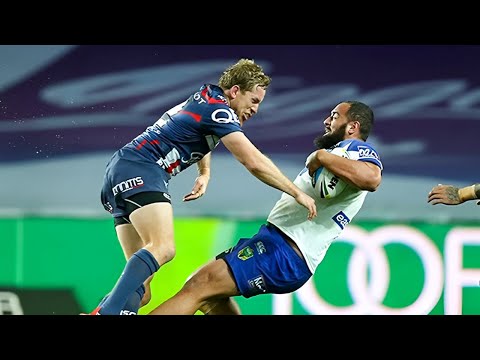
Biggest Run It Straight Moments in Rugby/Rugby League
YouTube · Sideline
Pages
On this page
Sport on Earth › Sports
Sport on Earth · Sport
Thirteen a side with six tackles per possession. A faster, more continuous game than union.
Split from union in northern England in 1895 over payments to players.
Professional: NRL in Australia and NZ, Super League in England and France, State of Origin.
College and school: Strong school and junior pathways in Queensland and NSW.
Grassroots and other: Community clubs, nines, touch football.
NRL from March to October; State of Origin mid-year; World Cup every few years.
Dates above are recurring patterns, not confirmed fixtures.
Sport on Earth’s daily and weekly video shows for Rugby League — every episode, newest first.
The first episode is in production and lands here the morning it is produced — no episode is listed until it exists.
Every embed below was verified playable before listing — the network’s standing rule.
YouTube · Sideline
Pages
On this page
Real pinball on a table themed for this sport — the game carries a Rugby theme.
A new set of questions every day, across every sport this site covers.
Real-athlete Top Sport on Earth decks built from the site’s verified board data.
Rugby League's lab is the Physics Lab section on this page — the applied physics of its sport family, with a computed interactive where one honestly fits.
Physics Arena — the general biomechanics & physics teaching sandbox, shared by every sport.
The homepage sport explorer also carries a general Lab tab of small interactive experiments.
Calendar data not yet carried for Rugby League — this site does not yet hold schedule data for it, so no dates are shown rather than invented.
Which section of this page should we expand first?
Votes are counted on the Sport on Earth server and the totals shown are every reader’s votes; your own choice is remembered in this browser.
Rugby league’s two great professional competitions anchor its calendar. The site’s rugby league desk carries the Australian board; ESPN’s rugby-league directory serves a single league code (’3’), the Super League below.
Source basis: ESPN core API rugby-league directory (1 league code), probed November 1, 2026; league records.
NRL from March to October; State of Origin mid-year; World Cup every few years.
Almost every decisive action in an invasion game is a projectile problem: a kicked, thrown or struck ball follows a parabola set by its launch speed, angle and spin, bent by gravity and dragged by air. The calculator below is that core model — the same projectile maths the site’s Physics Arena teaches — with the assumptions printed: no air resistance, no spin, flat ground.
The second physics of invasion games is geometry: passing lanes are lines of sight, and the effective playing area shrinks or grows with team shape. Spin (curl and dip on struck balls) comes from the Magnus effect — a spinning ball deflects toward the side where its surface moves with the airflow.
From this sport's own record: Thirteen a side with six tackles per possession. A faster, more continuous game than union. The lab above treats the physics of the sport's family; no measurement specific to this sport is printed, because the site's verified record for it carries none — parameters are never invented to fill a lab.
Model: R = v²·sin(2θ)/g, flight time T = 2·v·sin(θ)/g, apex H = (v·sin θ)²/(2g), g = 9.81 m/s². Assumptions: no air resistance, no spin, flat ground, launch and landing at the same height. Real balls and shuttles fly shorter and curve — drag and spin are exactly what this model leaves out, so treat the output as the gravity-only ceiling, not a prediction.
The general teaching sandbox for every sport is the Physics Arena on the Games page — the same printed models, with a defender added.
The hands-on lab for Rugby League, built entirely from the record this site carries for it — its documented rolls, its halls, its venues, its calendar and its census family. Every figure below is computed from that carried record at build time; nothing is estimated and nothing is pulled live. The companion Physics Lab on this page works the family's physics; this lab works the record.
Computed from the roll itself: 29 editions carried (1998–2026). Most titles in the carried roll:
Basis: the documented dataset “NRL Grand Final results” carried on this site (Sport on Earth’s documented datasets). Counts are computed from the carried rows only — editions the roll does not carry are not estimated.
Computed from the roll itself: 29 editions carried (1998–2026). Most titles in the carried roll:
Basis: the documented dataset “Super League Grand Final results” carried on this site (Sport on Earth’s documented datasets). Counts are computed from the carried rows only — editions the roll does not carry are not estimated.
Rugby League carries 2 halls in the site’s record — Rugby League Hall of Fame · Australian Rugby League Hall of Fame — with 182 inductees carried, 170 of them with a full verified profile on this site.
Inductions by decade (computed from the carried induction years):
Basis: the Hall of Fame record carried on this site — the same rolls and verified profiles the Hall of Fame books print. Inductees a hall lists but the site has not verified stay list-only, exactly as the books state.
The carried global venue dataset holds 123 venues for Rugby League across 9 countries. The largest capacity the dataset records for this sport is 93,000 — White City Stadium, .
Basis: the global venue dataset carried on this site (6,438 venues with coordinates; the venue explorer on the sports index and the stadium sun table work the same data). Countries beyond the 25 largest are counted in the totals above but not listed here.
Computed from the site census: the Invasion field games family holds 61 entries on this site. Across the family, the carried record includes documented rolls for 8 of them, Hall of Fame data for 10, venue sets for 17, and dated calendars for 9.
Every other entry in the family: American Football · Arena Football · Athletes Unlimited · Atya patya · Australian Rules Football · Beach Handball · Beach Soccer · Bo-taoshi · Boxball · Buroinjin · Buzkashi · Calcio Storico · Camogie · Canadian Football · Cestoball · Chinlone · Circle Rules Football · Cuju · Cycle Ball · Cycle Polo · Dibeke · Dodgeball · Double Ball · Eton Wall Game · Field Hockey · Flag Football · Floorball · Football (Soccer) · Four Square / FS Handball · Futsal · Gaelic Football · Gaga Ball · Goalball · Handball · Hurling · Ice Hockey · Jombola · Jugger · Kabaddi · Kai Wed · Kho kho · Kibasen · Knapan · Kronum · La Soule · Lacrosse · Ladies’ Gaelic Football · Langa · Langdi · Quadball · Ringette · Rollball · Rugby Union · S.P.U.D. · Sepak Manggis · Shinty · Squalleyball · Touch · Ulama · Wheelchair Rugby
Basis: the Sport on Earth census itself — the same 460-entry register the census page prints.
The sponsorship record of Rugby League — title sponsors, jersey and kit deals, venue naming rights, firsts and record deals — from published sources only. Current deals are tracked on the Money Desk sponsorship page.
In 2001 Australia's largest telecommunications provider Telstra became naming-rights sponsor of the NRL, and the competition became the NRL Telstra Premiership. It has been known by that name ever since, before which it was simply the National Rugby League, formed in 1998 after the Super League war.
In November 2015 Telstra announced a five-year naming and mobile digital rights extension, saying it would extend a 17-year partnership and retain naming rights of the NRL premiership. Telstra described the renewed partnership as spanning more than two decades and one of the longest-running in Australian sports history.
Super League began in 1996 with Stones Bitter continuing as title sponsor, having sponsored the old First Division since 1986, as the Stones Super League in 1996-1997. JJB Sports signed a two-year deal in 1998, and Tetley's Bitter became the third sponsor with a five-year deal from 2000 as the Tetley's Super League.
Engage Mutual Assurance signed Super League's longest deal to date in 2005, six years as the Engage Super League including naming rights to the playoffs and Grand Final. Stobart Group followed in 2012 on a three-year deal with a 12-month opt-out, and 2013 was the only season with no title sponsor.
First Utility signed a three-year deal from 2014, thought to be worth around 750,000 pounds a year. Betfred then became the first bookmaker to sponsor Super League, in a deal believed to be worth between 850,000 and 900,000 pounds a year, with the league known as the Betfred Super League from 2017 through 2026.
The Challenge Cup was the first rugby league competition to be sponsored, in 1980, when the RFL signed a five-year deal with State Express. The RFL Championship was also sponsored from 1980, first as the Slalom Lager Championship before Stones Bitter from 1986.
Sponsorship sources: Wikipedia - History of the National Rugby League · Wikipedia - Super League · League Unlimited - Telstra naming rights extension · Alchetron - English rugby league sponsorship
How this game is played, gathered from the record Sport on Earth already carries for Rugby League, with the positions taken from the sourced chart cited in that section.
Thirteen a side with six tackles per possession. A faster, more continuous game than union.
Rugby league rewrites itself faster than any comparable sport — the NRL in particular treats its rulebook as a product under continuous development. Its signature modern changes are about one thing: keeping the ball in play and the collisions honest.
The current rules, as the site's rule-change dossier records them:
The full dossier — every dated change and named rule, with its source basis — is in this page’s Rule Changes & Named Rules section.
The positions for Rugby League, as carried from the source cited below:
Positions source: International Rugby League — Laws of the Game: the 13 numbered positions are fixed by the laws, with set numbers per position.
Its Playbook — its opening entries, the basic plays, are:
The full book carries 12 entries — in this page’s Playbook / Tactics & Strategy section, and at the Playbooks hub.
Sport on Earth's own analytics: every figure in this panel is computed at build time from the record this site itself carries, with the source named. No outside data is used, and no betting figures of any kind.
Computed from the site's documented champions datasets — the same rolls behind the Parity Tracker.
Hall of Fame record carried: 182 inductees across 2 hall(s); inductions span 1981–2024; the largest induction decade is the 2000s (107 inductees).
Source: the site's carried hall-of-fame record (historical-players.json).
Venues carried: 123 in 8 countries; the largest carried capacity is 93,000 (White City Stadium).
Source: the site's global venue record (venues-global.json); a capacity is printed only where the record carries a verified one.
Census arithmetic: Rugby League sits in the goal & invasion games family — 60 census sports, of which 12 carry a qualifying champions roll in the site's record.
Rugby league rewrites itself faster than any comparable sport — the NRL in particular treats its rulebook as a product under continuous development. Its signature modern changes are about one thing: keeping the ball in play and the collisions honest.
Before: Drawn regular-season matches stood as draws after 80 minutes — two competition points shared — and finals could require midweek replays in the sport’s earlier eras.
The change: The NRL introduced golden point in 2003: up to ten minutes of extra time (two five-minute halves, now played as a single period in current practice), first score of any kind wins. Super League followed. Draws survive only if golden point produces nothing.
Why it happened: The change was television-era showmanship borrowed conceptually from soccer’s golden goal (itself being abolished in soccer that same period for over-caution — league’s version, with field goals available, produced a different pathology: teams marching to drop-goal range rather than hunting tries).
In practice today: Golden point remains the regular-season decider; its field-goal shootouts are now criticised exactly as soccer’s golden goal was, and periodic proposals (golden try, points-splitting reforms) keep the debate permanently open.
Before: The shoulder charge — a defender launching his shoulder into the ball-carrier with no attempt to wrap the arms — was league’s signature collision and highlight-reel staple, celebrated in promotional footage.
The change: The ARL Commission banned it outright for 2013 (penalty, judiciary grading, suspension for contact with the head), with other major competitions following. Tackling now requires a genuine attempt to wrap or hold with the arms.
Why it happened: The ban belongs to the concussion era’s arrival in Australian sport: medical advice on head-injury risk, a series of ugly incidents, and a sport that decided its most violent image had become a liability. It was bitterly contested by players and traditionalists at announcement — a useful measure of how far safety governance had moved.
In practice today: The shoulder charge is extinct in the professional game; tackling technique is coached arms-first from juniors, and the old hits live only in archive montages labelled with the era’s rules.
Before: Ruck infringements (holding down, hands in the play-the-ball) were punished with full penalties: stoppage, kick for touch or goal, a reset defensive line — so defences infringed deliberately to slow momentum, and games drowned in penalty goals and stoppages. The wrestle era was the result: defence had learned to buy restarts at the price of a penalty.
The change: From May 2020 (introduced mid-season, initially for ruck infringements, later extended to offsides and other offences in 2021), the referee may award ’six again’ — a fresh set of six tackles signalled by waving and a bell, WITHOUT stopping play. The tackled team’s punishment is more defending, delivered instantly.
Why it happened: It was a COVID-restart innovation with a tactical soul: the NRL’s 2020 relaunch needed speed, and head of football Graham Annesley’s project was to remove the defence’s option to concede a penalty as a breather. Introduced for ruck offences first, its success (ball-in-play time and fatigue-driven openness jumped) earned the 2021 expansion.
In practice today: Six again transformed the sport’s tempo and fatigue economics: defensive lines can no longer buy rest, momentum compounds brutally (the era of the 30-point comeback and the blowout both trace here), and ’set restart’ management is now a core coaching discipline.
Before: A field goal (drop goal) was worth one point from anywhere — a tiebreaker weapon, rarely more, because one point seldom changed the arithmetic versus a try’s four.
The change: From 2021, a field goal kicked from beyond the 40-metre line is worth TWO points. Long-range drop goals — a dying art of speculative 45-metre attempts — became a rational late-game play.
Why it happened: The ARLC’s entertainment agenda again: trailing teams needed another comeback lever, and the league wanted to revive the long field goal as a spectacle (its union cousin, the three-point drop goal, had always mattered more). Halfbacks with big boots became late-game assets overnight.
In practice today: The two-point field goal now shapes endgame strategy — teams set deliberately for the 41-metre strike when down by two — and has produced a small library of match-winners that the one-point era would never have attempted.
Source basis: NRL rule-change announcements (2003, 2013, 2020, 2021) and ARLC documentation; Super League adoption records.
Sport on Earth carries no results feed for Rugby League: no scores or fixtures are published here, rather than inventing them. The sport's documented record is in its history page and the History & Records section of this page.
The historical record for Rugby League — past standings, champions, title history and all-time leaders, as deep as verifiable public records go.
| Year | Winners | Score | Runner-up |
|---|---|---|---|
| 1998 | Wigan Warriors | 10–4 | Leeds Rhinos |
| 1999 | St Helens | 8–6 | Bradford Bulls |
| 2000 | St Helens | 29–16 | Wigan Warriors |
| 2001 | Bradford Bulls | 37–6 | Wigan Warriors |
| 2002 | St Helens | 19–18 | Bradford Bulls |
| 2003 | Bradford Bulls | 25–12 | Wigan Warriors |
| 2004 | Leeds Rhinos | 16–8 | Bradford Bulls |
| 2005 | Bradford Bulls | 15–6 | Leeds Rhinos |
| 2006 | St Helens | 26–4 | Hull F.C. |
| 2007 | Leeds Rhinos | 33–6 | St Helens |
| 2008 | Leeds Rhinos | 24–16 | St Helens |
| 2009 | Leeds Rhinos | 18–10 | St Helens |
| 2010 | Wigan Warriors | 22–10 | St Helens |
| 2011 | Leeds Rhinos | 32–16 | St Helens |
| 2012 | Leeds Rhinos | 26–18 | Warrington Wolves |
| 2013 | Wigan Warriors | 30–16 | Warrington Wolves |
| 2014 | St Helens | 14–6 | Wigan Warriors |
| 2015 | Leeds Rhinos | 22–20 | Wigan Warriors |
| 2016 | Wigan Warriors | 12–6 | Warrington Wolves |
| 2017 | Leeds Rhinos | 24–6 | Castleford Tigers |
| 2018 | Wigan Warriors | 12–4 | Warrington Wolves |
| 2019 | St Helens | 23–6 | Salford Red Devils |
| 2020 | St Helens | 8–4 | Wigan Warriors |
| 2021 | St Helens | 12–10 | Catalans Dragons |
| 2022 | St Helens | 24–12 | Leeds Rhinos |
| 2023 | Wigan Warriors | 10–2 | Catalans Dragons |
| 2024 | Wigan Warriors | 9–2 | Hull Kingston Rovers |
| 2025 | Hull Kingston Rovers | 24–6 | Wigan Warriors |
| 2026 | Wakefield Trinity | 23–10 | Warrington Wolves |
Source basis: Wikipedia — “Super League Grand Final” (accessed Nov 1, 2026); parsed mechanically from the article’s published table. Material from Wikipedia is used under CC BY-SA 4.0..
| Season | Winners | Score | Runners-up |
|---|---|---|---|
| 1998 | Brisbane Broncos | 38–12 | Canterbury-Bankstown Bulldogs |
| 1999 | Melbourne Storm | 20–18 | St. George-Illawarra Dragons |
| 2000 | Brisbane Broncos | 14–6 | Sydney Roosters |
| 2001 | Newcastle Knights | 30–24 | Parramatta Eels |
| 2002 | Sydney Roosters | 30–8 | New Zealand Warriors |
| 2003 | Penrith Panthers | 18–6 | Sydney Roosters |
| 2004 | Canterbury-Bankstown Bulldogs | 16–13 | Sydney Roosters |
| 2005 | Wests Tigers | 30–16 | North Queensland Cowboys |
| 2006 | Brisbane Broncos | 15–8 | Melbourne Storm |
| 2007* | Melbourne Storm | 34–8 | Manly-Warringah Sea Eagles |
| 2008 | Manly-Warringah Sea Eagles | 40–0 | Melbourne Storm |
| 2009* | Melbourne Storm | 23–16 | Parramatta Eels |
| 2010 | St. George-Illawarra Dragons | 32–8 | Sydney Roosters |
| 2011 | Manly-Warringah Sea Eagles | 24–10 | New Zealand Warriors |
| 2012 | Melbourne Storm | 14–4 | Canterbury-Bankstown Bulldogs |
| 2013 | Sydney Roosters | 26–18 | Manly-Warringah Sea Eagles |
| 2014 | South Sydney Rabbitohs | 30–6 | Canterbury-Bankstown Bulldogs |
| 2015 | North Queensland Cowboys | 17–16 | Brisbane Broncos |
| 2016 | Cronulla-Sutherland Sharks | 14–12 | Melbourne Storm |
| 2017 | Melbourne Storm | 34–6 | North Queensland Cowboys |
| 2018 | Sydney Roosters | 21–6 | Melbourne Storm |
| 2019 | Sydney Roosters | 14–8 | Canberra Raiders |
| 2020 | Melbourne Storm | 26–20 | Penrith Panthers |
| 2021 | Penrith Panthers | 14–12 | South Sydney Rabbitohs |
| 2022 | Penrith Panthers | 28–12 | Parramatta Eels |
| 2023 | Penrith Panthers | 26–24 | Brisbane Broncos |
| 2024 | Penrith Panthers | 14–6 | Melbourne Storm |
| 2025 | Brisbane Broncos | 26–22 | Melbourne Storm |
| 2026 | Sydney Roosters | 19–18 | Newcastle Knights |
Source basis: Wikipedia — “NRL Grand Final” (accessed Nov 1, 2026); parsed mechanically from the article’s published table. Material from Wikipedia is used under CC BY-SA 4.0..
| Year | Winners | Score | Runners-up |
|---|---|---|---|
| 1954 | Great Britain | 16–12 | France |
| 1957 | Australia | round-robin | Great Britain |
| 1960 | Great Britain | round-robin | Australia |
| 1968 | Australia | 20–2 | France |
| 1970 | Australia | 12–7 | Great Britain |
| 1972 | Great Britain | 10–10 ( a.e.t. ) | Australia |
| 1975 | Australia | round-robin | England |
| 1977 | Australia | 13–12 | Great Britain |
| 1985 | Australia | 25–12 | New Zealand |
| 1989 | 10–6 | Great Britain | New Zealand |
| 1995 | Australia | 16–8 | England |
| 2000 | Australia | 40–12 | New Zealand |
| 2008 | New Zealand | 34–20 | Australia |
| 2013 | Australia | 34–2 | New Zealand |
| 2017 | Australia | 6–0 | England |
| 2022 | Australia | 30–10 | Samoa |
Source basis: Wikipedia — “Rugby League World Cup” (accessed Nov 1, 2026); parsed mechanically from the article’s published table. Material from Wikipedia is used under CC BY-SA 4.0..
The review and analysis videos from Rugby League’s verified video pool — every embed below was identity-checked and probed playable before listing, the site’s standing rule. Nothing here is a show Sport on Earth produces; these are the review, post-game and breakdown videos the pool already carries for this sport.
No verified review-show video is carried for this sport yet.
The filter sorts the Review Room embeds and the picture cards above by the keywords in their carried titles (review / analysis / recap and similar, or highlights). It runs entirely in your browser — nothing is sent anywhere.
This page carries both principal rugby league halls: the British Rugby League Hall of Fame and the Australian Rugby League Hall of Fame.
United Kingdom (administered by the Rugby Football League)
41 inductees — every name on the hall's published list, grouped by class year.
1988 — Harold Wagstaff (Centre) · Jim Sullivan (Fullback) · Albert Rosenfeld (Wing) · Gus Risman (Centre) · Jonty Parkin (Scrum-half) · Alex Murphy (Scrum-half) · Billy Boston (Wing) · Brian Bevan (Wing) · Billy Batten (Centre)
1989 — Neil Fox (Centre)
2000 — Roger Millward (Stand-off) · Tom van Vollenhoven (Wing) · Vince Karalius (Loose forward)
2005 — Martin Hodgson (Second-row) · Ellery Hanley (Loose forward) · Douglas Clark (Loose forward) · Eric Ashton (Centre)
2013 — Lewis Jones (Stand-off) · Martin Offiah (Wing) · Mick Sullivan (Wing) · Garry Schofield (Centre , Stand-off)
2014 — Mal Reilly (Loose forward) · Willie Horne (Stand-off)
2015 — Shaun Edwards (Scrum-half , Stand-off) · Albert Goldthorpe (Fullback , Stand-off)
2018 — Johnny Whiteley (Loose forward) · Derek Turner (Loose forward) · Andy Gregory (Scrum-half)
2022 — David Watkins (Fullback) · Clive Sullivan (Wing) · Adrian Morley (Prop Second-row) · Andy Farrell (Second-row Loose forward) · Sally Milburn · Lisa McIntosh · Brenda Dobek
2024 — James Lomas (Wing , Centre) · Alan Prescott (Wing , Prop , Second-row , Loose forward) · Jane Banks · Michelle Land · Paul Sculthorpe (Loose forward , Stand-off , Second-row) · Jamie Peacock (Prop , Second-row)
Source basis: Wikipedia — "Rugby League Hall of Fame" (accessed Nov 1, 2026); parsed mechanically from the article’s published table. Material from Wikipedia is used under CC BY-SA 4.0..
Sydney, Australia
141 inductees — every name on the hall's published list, grouped by class year.
1981 — John Raper
2002 — Clive Churchill · Johnny Raper · Reg Gasnier · Graeme Langlands · Bob Fulton · Wally Lewis
2003 — Dally Messenger · Wally Prigg · Dave Brown · Keith Holman · Arthur Beetson · Mal Meninga
2004 — Frank Burge · Harold Horder · Vic Hey · Harry Bath · Norm Provan · Ken Irvine
2005 — Chris McKivat · Duncan Thompson · Jim Craig · Brian Bevan · Brian Carlson · Ron Coote
2006 — Sandy Pearce · Charles Fraser · George Treweek · Duncan Hall · Ken Kearney · Peter Sterling
2007 — Arthur Halloway · Tom Gorman · Joe Pearce · Harry Wells · Keith Barnes
2008 — Billy Cann · Tedda Courtney · Albert Rosenfeld · Dan Frawley · Howard Hallett · Viv Farnsworth · Les Cubitt · Herb Gilbert · Cec Blinkhorn · Frank McMillan · Benny Wearing · Vic Armbruster · Eric Weissel · Dan Dempsey · Herb Steinohrt · Mick Madsen · Joe Busch · Ray Stehr · Ernie Norman · Viv Thicknesse · Jack Beaton · Andy Norval · Herb Narvo · Arthur Clues · Roy Bull · Brian Davies · Ian Walsh · Kel O’Shea · Brian Clay · Eddie Lumsden · Brian Hambly · Peter Gallagher · Noel Kelly · Barry Muir · Ken Thornett · Arthur Summons · Johnny King · Les Johns · Billy Smith · John Sattler · Bob McCarthy · John O’Neill · Tommy Raudonikis · Mick Cronin · Graham Eadie · Steve Rogers · Steve Mortimer · Ray Price · Kerry Boustead · Eric Grothe Sr. · Wayne Pearce · Terry Lamb · Brett Kenny · Gene Miles · Steve Roach · Andrew Ettingshausen · Steve Walters · Allan Langer · Laurie Daley · Glenn Lazarus · Bradley Clyde · Brad Fittler · Andrew Johns · Shane Webcke · Darren Lockyer
2018 — Mark Graham · Cliff Lyons · Ricky Stuart · Gorden Tallis · Steve Menzies · Petero Civoniceva
2019 — Craig Young · Ruben Wiki · Stacey Jones · Danny Buderus · J J Giltinan · Peter Frilingos · Ray Warren
2023 — Ian Heads · George Piggins
2024 — Lionel Morgan · Les Boyd · Benny Elias · Steve Renouf · Cameron Smith · Johnathan Thurston · Billy Slater · Benji Marshall · Cooper Cronk · Greg Inglis · Sam Burgess · Natalie Dwyer · Katrina Fanning · Tarsha Gale · Veronica White · Karyn Murphy · Tahnee Norris · Jack Gibson · Wayne Bennett · Frank Hyde · Ken Arthurson · John Quayle · David Morrow · Col Pearce · Bill Harrigan
Source basis: Wikipedia — "Australian Rugby League Hall of Fame" (accessed Nov 1, 2026); parsed mechanically from the article’s published table. Material from Wikipedia is used under CC BY-SA 4.0..
Full inductee profiles → 170 of the 182 inductees above carry a full verified profile — biography, induction record and verified video where one exists. The rest are list-only until a biography can be verified the same way.
The Rugby League record book, as this site carries it: its super league grand final results roll carries 29 editions, 1998–2026; its nrl grand final results roll carries 29 editions, 1998–2026; its rugby league world cup finals roll carries 16 editions, 1954–2022; the Rugby League Hall of Fame list carries 41 inductees (classes 1988–2024); the Australian Rugby League Hall of Fame list carries 141 inductees (classes 1981–2024); its rule-changes dossier records 4 dated changes and named rules. Every figure above is computed from the lists and dossiers printed on this page, each with its source basis named beside it.
More from the desk: the expert guide to Rugby League · the site-wide Writing Desk · every sport on Earth.
📖 The Rugby League Playbook — every entry, plus the arcade strategy, at the foot of this page.
An arcade take on Rugby League: set the angle, set the power, and land the ball in the goal mouth. Five attempts; the closer to the middle, the more it scores. Arcade distances and a training arc — a game in the spirit of the sport, not a simulation of it.
This page’s own game is the arcade above. Everything else on the site that fits this sport is listed here — and anything borrowed from a similar sport is labelled as that sport’s game, never passed off as this one’s.
2 verified documentaries, films and series about this sport are listed in the site's screen guide: Sport on Screen — Rugby League.
The tools on this site that honestly run on Rugby League — its own record first, then the site-wide general tools that apply. The full Rugby League toolkit prints the ones that do not apply, with the data reason why.
Site-wide tools, not built for Rugby League alone: Tournament Planner · My Notebook · The Labs · Design Studio · The Makers’ Bench · Match Day Desk · Play It Near You · Myth-Check Desk · Governing Bodies · Heat & Safety Calculator (WBGT) · Hydration Calculator · Training-Load Planner · Game Clock & Timer · Custom Rulebook Generator · Scout Notes Parser.
Players: Rugby League Players Association — The official representative body for elite rugby league players in the NRL, NRLW and elite NSWRL and QRL competitions, formed in 1979, safeguarding and advancing members’ wellbeing and negotiating their share of NRL revenue under the CBA.
Officials: NRL Elite Officiating (federation arm) — The National Rugby League’s own elite officiating operation covering its match officials and bunker review system, run as a league department rather than an independent officials’ association.
Verified associations for this sport, from the sources listed on the players' associations and referees' associations pages.
The Playbook · set plays, systems & situations
rugby league’s documented vocabulary — the six-tackle set is a scripted sequence, and league’s shape plays are the most rehearsed in either code.
12 entries, plus the arcade strategy below. All wording is original coaching-vocabulary prose; nothing is copied from any proprietary playbook.
League’s basic unit is not a play but a script: five structured tackles to earn field position and shape the defence, spent so the last-tackle kick lands where the set was aimed from the first carry.
When it’s used: Every league coach plans backwards from the kick: the set is one play in six acts.
The sequence
The half runs at the line with a forward decoy charging beside him and the fullback sweeping behind — three options in one picture, and the defence must defend all of them with two men.
When it’s used: League’s signature attacking shape, run by every professional side on every edge.
The sequence
The ball carrier runs back against the grain of the defence’s slide, angling inside the sliding defender’s outside shoulder — the line that punishes drift defences all afternoon.
When it’s used: When a defence slides too eagerly toward the ball’s movement, the space it leaves is behind it.
The sequence
The decoy who runs the line the pass is not taking — charging outside the ball player’s shoulder as if to receive, holding the edge defence wide while the ball goes elsewhere.
When it’s used: League’s shapes only work because the decoys are honest: every lead runner runs to score.
The sequence
Late in the set, the half rolls the ball along the ground behind the rushing defence for chasers to dive on — the kick that turns line speed into doubt.
When it’s used: On tackle four or five near the line, against a defence sprinting up: their speed is the space behind them.
The sequence
The last-tackle kick goes high and to a spot, not long and to a man: the chasers arrive with the ball and contest the catch in the air.
When it’s used: The default last-play of the league set — field position with a lottery ticket attached.
The sequence
Classic · a rule that built a play
From inside his own 40, the kicker who finds touch inside the opposition’s 20 wins his side the ball back with a fresh set — the rule that makes league’s kicking game an attacking weapon.
When it’s used: Rewarded by the rules themselves: the 40/20 is league’s home run.
The sequence
The hooker, seeing markers split or slow to set, darts from the play-the-ball himself — the cheapest metres in league, bought with the defence’s own reset time.
When it’s used: Whenever the markers are lazy: the scoot is the tax they pay.
The sequence
Modern · ruck speed as system
Forwards aim not just to gain metres but to be tackled on their front, elbows and knees down fast, so the ball is back in play before the defence retreats the ten — momentum as a designed weapon.
When it’s used: Modern league is played at the speed of its slowest ruck; this is the counter.
The sequence
On their own line, league defences hold a compressed line that folds inward from the edges: the first defender buys time, the line slides behind him, and the ball is pushed toward the corners where angles die.
When it’s used: Six tackles from a metre out: goal-line defence is league’s purest examination.
The sequence
Restarting, the kicking side goes short on purpose — ten metres, contested — trading certain possession of territory for a coin-flip at the ball itself.
When it’s used: Trailing late, or against a side whose short-restart defence is known to be soft.
The sequence
League’s review system shapes play itself: sides defend the ball in tackles near their line knowing a challenge can overturn a strip call, and save their challenge for the calls that change sets, not metres.
When it’s used: A tactics entry, honestly labelled: the challenge is a resource, spent like the sets themselves.
The sequence
The arcade cell · strategy
This page’s arcade cell: launch the ball at the goal mouth from the penalty spot · 46 m (arcade scale). Angle, power, launch — five attempts, and the cell keeps your best.
When it’s used: On this page, in the Play section — and its strategy is the same craft as the book above it, miniaturised.
The sequence
Part of the Sport on Earth Playbooks — a book for every sport and every game on the site.
Behind the Play · Full treatment — from this sport’s own record
Thirteen a side with six tackles per possession. A faster, more continuous game than union.
Behind the Play takes the decisive actions of Rugby League apart: how the scoring play is built, which patterns the players are really running, and which rules remade the play into its modern shape.
Rugby league rewrites itself faster than any comparable sport — the NRL in particular treats its rulebook as a product under continuous development. Its signature modern changes are about one thing: keeping the ball in play and the collisions honest.
Golden Point (2003). The NRL introduced golden point in 2003: up to ten minutes of extra time (two five-minute halves, now played as a single period in current practice), first score of any kind wins. Super League followed. Draws survive only if golden point produces nothing.
Golden point remains the regular-season decider; its field-goal shootouts are now criticised exactly as soccer’s golden goal was, and periodic proposals (golden try, points-splitting reforms) keep the debate permanently open.
The Shoulder Charge Ban (2013). The ARL Commission banned it outright for 2013 (penalty, judiciary grading, suspension for contact with the head), with other major competitions following. Tackling now requires a genuine attempt to wrap or hold with the arms.
The shoulder charge is extinct in the professional game; tackling technique is coached arms-first from juniors, and the old hits live only in archive montages labelled with the era’s rules.
Six Again (the Set Restart) (2020). From May 2020 (introduced mid-season, initially for ruck infringements, later extended to offsides and other offences in 2021), the referee may award ’six again’ — a fresh set of six tackles signalled by waving and a bell, WITHOUT stopping play. The tackled team’s punishment is more defending, delivered instantly.
Six again transformed the sport’s tempo and fatigue economics: defensive lines can no longer buy rest, momentum compounds brutally (the era of the 30-point comeback and the blowout both trace here), and ’set restart’ management is now a core coaching discipline.
From this page’s Rule Changes & Named Rules dossier, where every entry names its source.
Source basis: this sport’s carried record on this page (verified record, rule-changes dossier, history datasets) and the play patterns of its family as written in the site’s guides. Nothing here is invented.